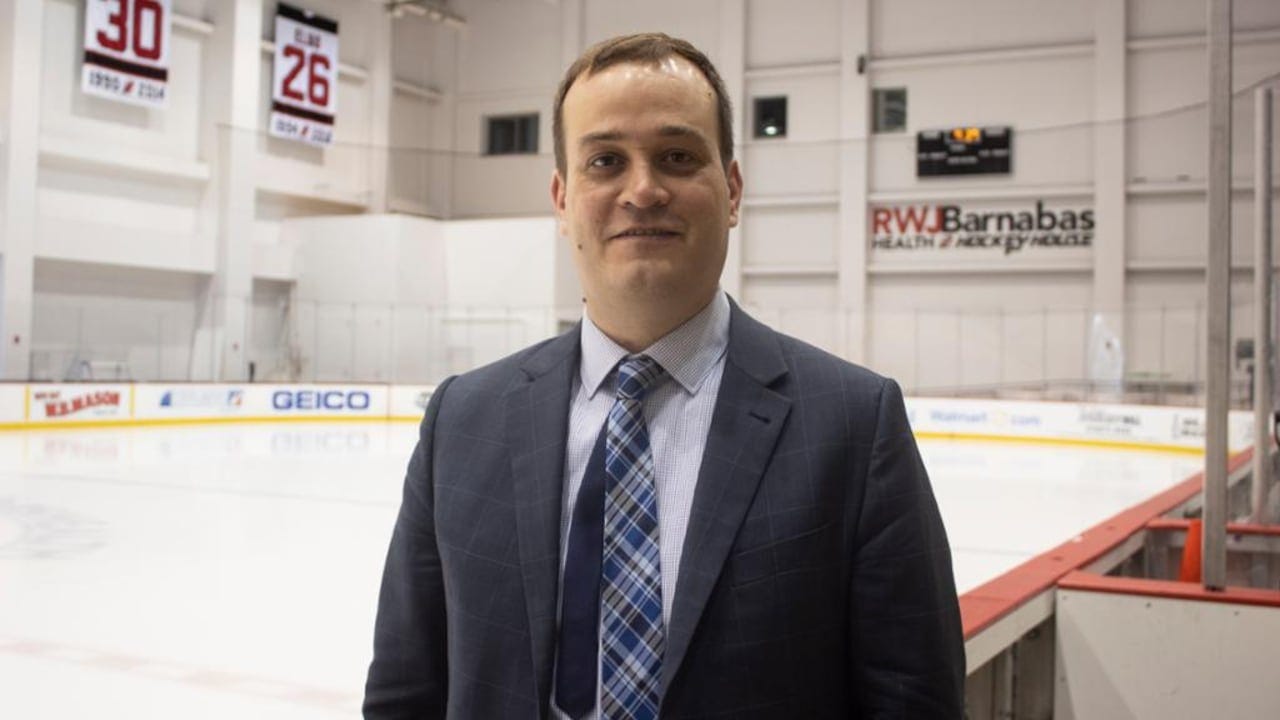
Red Wings GM Candidates: Tyler Dellow
Taking a closer look at potential candidates
Previous articles in this series:
Dallas Assistant GM Scott White
Buffalo VP of Hockey Strategy & Research Sam Ventura
In my previous article in this series I made the case for Sam Ventura as the next Red Wings GM. The takeaway from that article was that Ventura would be a very acceptable choice in MLB, but probably needs a few seasons as an assistant GM before moving up to the top spot in a hockey ops department. Today, we’ll look at another analytics-heavy candidate, but one who more closely matches Eric Tulsky’s rise as the first analytics GM to win the Stanley Cup.
Like Ventura, Tyler Dellow set up shop on his own website at MC79hockey to share his musings on how NHL strategy was often at odds with what was the best path for success, which has led to a career in three NHL front offices, beginning in Edmonton, with a stop in New Jersey before being hired by the Hurricanes to serve as assistant general manager for the past two seasons.
Dellow took a break between his stints with the Oil and Devils, and during that time was a contributor for the Athletic, which gives us insight into how he leverages data to inform hockey strategy. This has proven very helpful in understanding how he operates, and I’ll include a few examples in this article.
With that out of the way, let’s take a closer look at Tyler Dellow as our next candidate in this series.
Tyler Dellow’s Background
Like Tulsky and Ventura, Tyler Dellow first made a name for himself as a stats-based NHL blogger, in this case with his website MC79hockey. In between NHL front office gigs in Edmonton and New Jersey, he spent time at the Athletic, writing about hockey strategy through the lens of advanced analytics.
Dellow followed what has become the standard point of entry for an analytical contributor to an NHL front office: join first as a consultant before being promoted to a Director and/or VP level of the analytics department. The crucial difference with Dellow is he’s been an assistant GM for the past two years with the Carolina Hurricanes.
So if you want to hire someone with an analytical bent but who has also served the traditional assistant GM role in the lead-up to becoming GM, Dellow checks off all those boxes. Sunny Mehta, who worked alongside Dellow in the Devils organization before being hired by Florida, was recently hired to run the New Jersey Devils. It seems like a matter of when, not if, Tyler Dellow will be hired as an NHL general manager.
Putting it in simple terms, Tyler Dellow would be an easy choice as a GM in 2026, following the success of Tulsky and the recent hirings of John Chayka in Toronto and Mehta in New Jersey.
Tyler Dellow’s Track Record
For starters, I’m not going to bother digging into his time in Edmonton given he was a consultant. The reasons are twofold: one, it was a long time ago and his role was fairly minor; and two, it’s unlikely I’m going to find any meaningful data to help understand what his role was with the Oilers. The fact they let him go after two seasons likely says more about the state of the NHL in particular at that time with regard to the slow embrace of analytics than anything Dellow likely did to deserve not being retained.
There was some speculation that perhaps his take on the Taylor Hall for Adam Larsson trade may have played a role in Edmonton not renewing his contract, but that speculation was likely drawing far too heavily from Matt Pfeffer’s exit around the same time from Montreal regarding the PK Subban trade which he publicly blasted. While that’s undoubtedly a more salacious story, the truth is likely based around the circumstances of Peter Chiarelli becoming Edmonton’s GM around the time of Dellow’s exit: the new GM may have simply decided to go in a new direction with his preferred hires, resulting in Dellow not being retained.
Regardless, Hall eventually ended up in Carolina with Dellow and played a big role in helping the Canes claim the Cup.
Cool story, though.
I’m also not inclined to spend too much time reviewing Dellow’s time with the Devils, as his most recent stint with Carolina provides plenty of activity to provide a fruitful overview of his capabilities as an NHL exec where he held a primary role as an assistant general manager.
Carolina Hurricanes: 2024-25 to Present
In Dellow’s first two seasons with the club, the Canes made three big trades that helped push them over the top this past season. I covered this in some detail in a recent article where I made the case that Carolina’s success could be copied by the Red Wings.
The first of these trades was the acquisition of Mikko Rantanen, which on the surface was wildly unsuccessful: Rantanen only played 13 games for Carolina, making it clear he had no interest in signing an extension to extend his stay in North Carolina. That looked to be a very steep price to have paid when the Canes sent Martin Nečas the other way to Colorado in the deal. As a side note, the Canes also received the aforementioned Taylor Hall from Chicago as part of this trade package.
Facing the reality of Rantanen’s intransigence, the Canes pivoted, and with their trade of Rantanen to Dallas, sowed the seeds that led to their second Cup win in franchise history. The trade returned Logan Stankoven, who played a key role for Carolina after being moved to center, and a first round draft pick Dallas sent to the Hurricanes was used to acquire defender K’Andre Miller from the Rangers.
Hall, Stankoven, and Miller were all strong contributors to the Hurricanes’ championship run, and there’s plenty of reason to believe Dellow would have been consulted in acquiring each of these players.
So that’s a massive win.
Then there’s the current cap situation in Carolina, which is among the best in the league. The Canes are known for setting player values based on their production and are committed to sticking to those valuations.
It’s worked out brilliantly.
The Canes currently have just under $10 million in cap space with 13 forwards, 6 defenders and 2 goaltenders under contract. They still need to sign RFA defender Alexander Nikishin, and there’s been talk of them making him available as a trade piece. Regardless, their cap situation is among the best in the league.
Their only bad contract is Jesper Kotkaniemi’s four remaining years at just over $4.8 million per season, which takes up just 4.6% of the $104 million cap ceiling.
That’s nothing.
So while I don’t know exactly what role Dellow plays in determining player values, he’s part of a team that is killing roster contruction from a performance and salary standpoint. Just about every one of their key players is locked up in a team-friendly contract through the 2030-31 season.
When it comes to the draft, Dellow hasn’t been there long enough to establish much of a track record. Then there’s the fact the Canes haven’t had a first round draft pick over the past three summers.
So there’s nothing we can take from those drafts — good or bad.
Finally, the Canes have dominated the Corsi For and Fenwick For stats every year since the 2022-23 season, indicating they tilt the ice in their favor better than every other club. In 2021-22 they finished second to the Florida Panthers.
You have to go all the way back to the 2016-17 season to find a year when Carolina wasn’t top 5 in the league Corsi For or Fenwick For. All this is to say that while Dellow no doubt sees the value in tilting the ice, the Canes have been successfully doing so long before he arrived.
One data point I’ll include from Dellow’s time in New Jersey is that when he arrived in 2019 the Devils were one of the three worst teams in the league in Corsi For and Fenwick For percentages; by his final two seasons with the club, New Jersey was a top 5 team in tilting the ice in their favor.
Dellow’s Analytical Background
In addition to his analytics-focused website, Dellow’s penchant for sharing his ideas led to him writing for the Athletic, which gives us more insight into how he uses data to inform hockey strategy. Here’s one example, where he discuses the evolving strategy of which players to use with the man advantage:
One of the things that analytically inclined people have muttered about, dating back to at least the early part of the century, is the refusal of coaches to move away from three forwards and two defencemen (3F2D) at 5v4. The argument in favour of using four forwards and one defenceman (4F1D) is simple: You score more goals in a 4F1D than you will in a 3F2D.
You’ll give up a few extra shorthanded goals, but the benefit more than outweighs the cost.
Year after year, a 4F1D produces better goal difference.
This is a simple and fairly straightforward example, made even more salient by the fact the NHL — which is very much a tradition-based league — has largely moved to the 4F1D set up with the man advantage.
Like Sam Ventura, Tyler Dellow has actively participated in the MIT Sloan Sports Conference, and he shared his views on one such conference when he was writing for the Athletic; in that article he talked in broad terms about how hockey was beginning to follow the well worn path of MLB and the freshly trod path of the NBA when it comes to embracing analytics.
…hockey is progressing in that there is a growing body of young, smart researchers well versed in what’s been done to date and the wrinkles of analysis of the sport. Academics are starting to take an interest in analyzing the sport. Large pools of privately held data are starting to be available. Unfortunately, there are some barriers that exist between the three that are holding things back.
This article is nine years old and we can confidently say the role of analytics has only grown within hockey. As a humorous side note, the Florida Panthers presented at this particular conference and apparently shared how they used data to select Henrik Borgstrom with the 23rd overall pick.
Who? Exactly: it turns out the data they used that couldn’t identify a comparable who had a successful NHL career was in fact accurate.
Another of his articles for the Athletic focused on face-offs outside of those that take place at center ice.
The net effect of this is that lefties have a platoon split depending on whether the faceoff is on their strong or weak side. They tend to be markedly better on their strong side. Platoon split is a baseball term referring to the difference in stats batters have against pitchers depending on their handedness. Righties don’t really have one. In other words, the real advantage of being on your strong side comes from having an opponent on his weak side. That happens a lot more for lefties than for righties because of the NHL’s handedness split. It shows up in the rates at which they win faceoffs on their strong and weak sides.
Dellow seems to have a very good handle on how to parse data to highlight key trends and leverage that data in ways that will show up on the ice and help teams perform better.
This is perhaps the best trait for an NHL GM.
Is Tyler Dellow a Good Choice?
In a word: yes. In two words: hell yes.
Dellow checks off all the boxes: he’s a leading analytics-based hockey exec, he’s spent nearly a decade in three separate NHL front offices, with the last two years spent serving as assistant GM for one of the most successful franchises in the league. He’s also learned at the side of the first analytics-heavy GM to break through and win a Stanley Cup. Eric Tulsky served as an AGM for Carolina before being promoted to GM, and Tyler Dellow is on that exact career path. He’ll get an NHL GM job if he wants one, and he won’t have to wait long.
There was some talk of him being a candidate for the Toronto job, but either he never interviewed or he didn’t make it far enough along in the process — as John Chayka and Scott White were reported to be the finalists — so I’m not sure what his appetite is at this time regarding taking over an NHL club. However these jobs don’t come open often — the last time Detroit hired a GM from outside the organization was Jimmy Devellano all the way back in 1982 — so if he gets a call to interview, he may need to weigh his options carefully. If Chris Ilitch thinks he’s ready, well then it’s entirely his call.
While Dellow doesn’t have the decades long track record of a candidate like Scott White, he’d be a bullseye regarding the key attribute Chris Ilitch is said to be prioritizing, and he has the requisite background where becoming a GM to run his own franchise would be a logical next step.
LFG.


