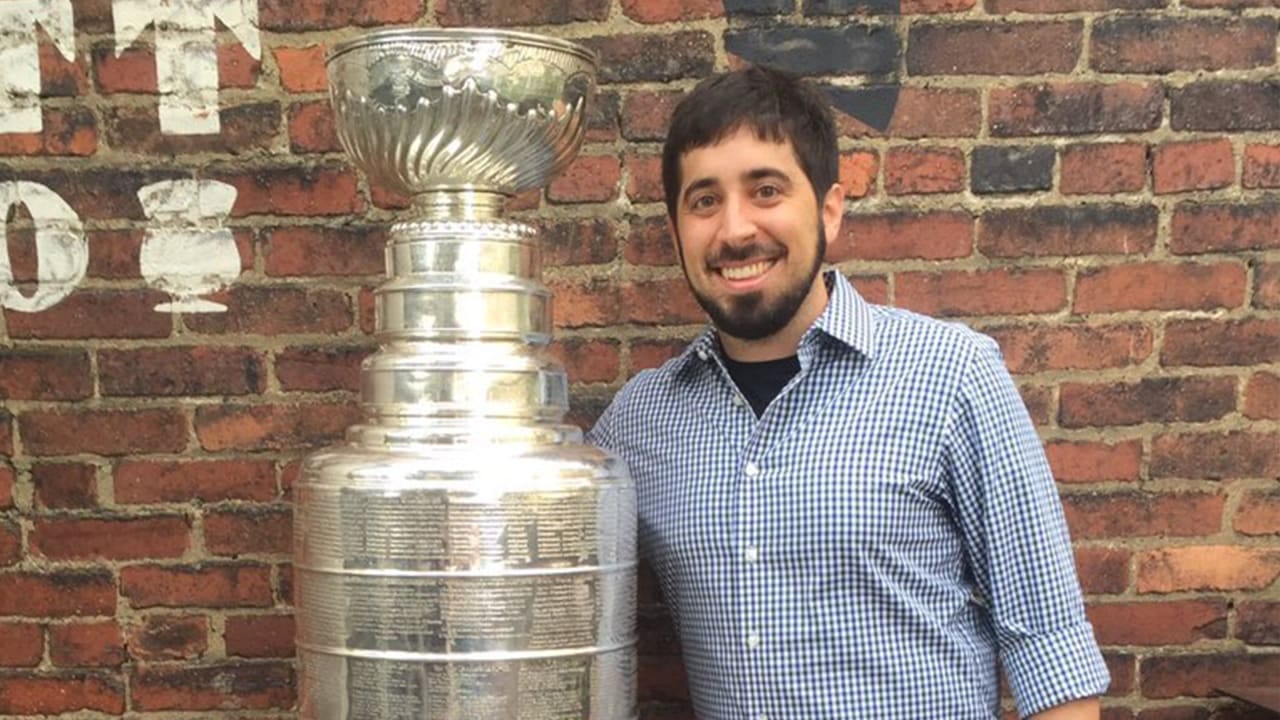
Red Wings GM Candidates: Sam Ventura
Taking a close look at potential candidates
Credit: NHL
Let me begin by saying there is absolutely nothing to indicate Sam Ventura will get an interview with the Detroit Red Wings. However, when you look at the recent success of Eric Tulsky with the Carolina Hurricanes, and you consider that most poorly performing sports teams tend to be copy cats when it comes to cribbing what they view as the ‘secret sauce’ that separates the contenders from the pretenders, you may think that perhaps Sam Ventura’s time has come.
Ventura is a pure analytics-based candidate, having co-founded the War on Ice website that tracks advanced NHL stats. He’s spent the past 10 years working for the Pittsburgh Penguins and Buffalo Sabres’ front offices, which is enough NHL experience to make him worthy of at least an interview.
Hence, this article.
In a sport like baseball, hiring a candidate with Ventura’s background wouldn’t raise eyebrows, but we’re talking about a GM role in the NHL. I do think Chris Ilitch is one of the more progressive owners in pro sports, so today we’re going to consider Sam Ventura’s candidacy.
Sam Ventura’s Background
Ventura first made a name for himself with his advanced stat website War On Ice. You can still check out some of his posts on the blog section of the website. It became somewhat common for advanced stats bloggers to make their way to jobs within NHL franchises in the 2010s and Ventura was hired by the Penguins in 2015, beginning his NHL career as a ‘team consultant’. After two years as a consultant, he was bumped up to Director of Analytics with a title of Director of Hockey Research tacked on for good measure.
After 6 years with the Pens, he was hired by the Sabres to serve as their VP of Hockey Strategy and Research along with the previously held title of Director of Analytics. He’s been with the Sabres for 5 seasons and the organization looks to have finally turned the corner after 14 years of missing the playoffs.
What makes Sam Ventura GM material? It’s not entirely clear cut at this moment in time, as only one person thus far has followed a similar path to Ventura’s; but if we look at Eric Tulsky’s path to the GM chair, we can begin to chart a course for Sam Ventura.
Ventura has talked a bit about the growing role his analytics team in Buffalo has within the organization:
…we're going to be not just providing information for the draft, but for free agency and for Kevyn [Adams], and Jason [Karmanos] and (assistant general manager Mark Jakubowski) to use in all the decisions that are made in hockey operations on the management side, and then also there's going to be information that will be flowing into the hands of our coaching staff, the staff in Rochester, our scouts.
That short quote gives some insight into how analytics has come to drive decision-making throughout a hockey operations department. If data is going to inform decision making across the hockey ops department, it stands to reason the guy who leads the efforts to assemble, clean, produce and then shape the key details could oversee the entire hockey ops department.
So Ventura has the bonafides that would make him an intriguing MLB candidate, if not an NHL GM. He has an Econ degree from Carnegie Melon and he’s spoken at the MIT Sloan Sports Analytics Conference, an All Star game of sorts for people on the leading edge of sports analytics.
Sam Ventura’s Track Record
This part is going to be understandably tough to parse out. The Pens won back to back Cups shortly after Ventura arrived, but it may stretch credulity to suggest a ‘team consultant’ played a key role in those playoff runs. Since those back to back championships, the Pens have made it past the first round exactly once, which took place the following year; that’s not a particularly notable track record for a team with Sid Crosby, Evgeni Malkin, Kris Letang, Phil Kessel, Patric Hornqvist, and Jake Guentzel.
There weren’t any notable draft picks during the time Ventura worked for the Pens, so this is another area where a person with an analytical background would potentially play a key role; alas that did not happen: Daniel Sprong leads all Pittsburgh draft picks over that time frame with 374 career NHL games played.
To be fair, the Pens only had 1 first round draft pick during that time frame, which makes the odds of finding a quality NHL player quite challenging.
Ventura has talked about how Buffalo’s plethora of early draft picks played a role in his interest in working for the Sabres:
The biggest [benefit of working for the Sabres] is having many more draft picks than what we had in Pittsburgh. The state of the team there was that we were trying to win the Cup every year and, as a result, you know, you end up trading a lot of draft picks when you're trying to do that.
If Ventura’s time in Pittsburgh with a Penguins team that was underwhelming doesn’t inspire confidence, his time in Buffalo isn’t going to do much to change that perception. The Sabres missed the playoffs for the first four years of Ventura’s time there, with their highest point total being 91 points in the 2022-23 season. This past season was a massive improvement though, with Buffalo winning the Atlantic division with 109 points before losing in the second round to Montreal.
The turnaround in Buffalo perfectly coincided with the hire of Jarmo Kekalainen as general manager, so once again, it’s tough to make any definitive claims on the role Ventura played in the Sabres’ resurgence this past season.
The Sabres do have one breakout player they acquired through the draft during Ventura’s time, with 2023 #13 overall pick Zach Benson emerging as a high quality forward. The NHL website has an article that highlights the work Ventura’s team did in the lead up to that draft and how ecstatic they were when Benson fell to them in that draft.
As more data has become available to NHL scouting departments, some are using it to help drive their selections on draft day. Here’s a brief quote from the NHL.com article:
Using Benson as an example, Ventura pointed to his offensive talents, puck management, competitiveness, defensive commitment, and backchecking as attributes the team can now quantify when projecting a prospect’s success at the pro level.
“Checking so many of those boxes gives us a level of confidence about what his floor is on projection as an NHL player,” Ventura said. “And we apply that same kind of decision-making process to all draft-eligible players for which we have that data.”
So while there is at least one clear success story we have from Ventura’s time in Buffalo, that’s still a long way from saying he has the same qualifications as a traditional candidate who has run an AHL franchise or served as an assistant GM for an NHL club with a long track record of success. This is why I tend to consider MLB when thinking about whether Ventura would be a real option for Chris Ilitch.
MLB has a guy with a Latin Classics degree who is currently a General Manager. Andrew Friedman had no MLB experience when he impressed Tampa owner Stuart Sternberg with his views on baseball and quickly ascended to the GM role in Tampa. The Rays, it should be pointed out, contend in a division with the Yankees, Red Sox and Blue Jays, three of the biggest spending franchises in the entire MLB, which would understandably make the Tampa owner open to rolling the dice on a private equity guy with some Moneyball-inspired ideas.
So while it would be unprecedented for Venutra to jump directly from his current role in Buffalo into the GM chair in Detroit, it would be a fairly standard move in Major League Baseball, particularly for a team going through a long streak of failure and plays in a division that has ramped up to become the best in the sport.
That’s basically the case for considering Ventura for the GM role: he impresses Chris Ilitch with his ideas on how to turn the franchise around. I’ll readily admit it’s a stretch.
Ventura’s Analytical Background
Sam Ventura’s entire hockey career is based around analytics, both as a blogger and eventually as a member of an NHL front office. That alone would make him one of the top candidates if all we considered was advanced statistical analysis. The challenge with discerning the role of an analyst in a front office position is there is no set job description for this sort of role. At least with a GM for an AHL affiliate, the work bears striking resemblance to the role of an NHL GM, which is why I started off this series with Scott White.
Let’s take a look at a few key metrics for the Pens and Sabres over Ventura’s time with both clubs.
Pittsburgh Penguins: 2017-18 through 2020-21
I decided to limit the analysis of the Pens to the years when Sam Ventura had a clear role; that wasn’t the case during his first two seasons when he was merely listed as a ‘team consultant’. So these are the years he was Director of Analytics.
Overall, the Pens were very good at generating scoring chances (consistently top 10 in even-strength xGF) and — outside of the 2017-18 season — got reasonably good goaltending. For that 2017-18 season, they scored 28 fewer 5v5 goals that what the xGF suggested, and when you combine that with their spotty goaltending, they weren’t able to score their way out of those underlying issues.
It’s worth pointing out that shortly after they moved on from Marc-André Fleury, he had two +20 GSAA seasons (goals saved above average, with zero suggesting you stop what you should and nothing more) in 2017-18 and 2020-21, but he was no longer a rock solid #1 starter at that point in his career, with only one season where he played more than 60 games.
The big issues with those Pens teams is they were never much good in limiting 5v5 scoring chances against (middle of the pack in xGA) and it’s tough to say what role Ventura played in attempting to address that deficiency. This once again highlights the issue with trying to understand what Ventura was tasked with when working for the Pens. He can obviously discuss his role, KPIs and outcomes with Ilitch should he get an interview, but for those of us on the outside attempting to look in, there’s no real obvious needle mover when it comes to the big picture advanced stats.
The Pens were a gifted team at generating scoring attempts — no shock when you have Crosby, Malkin, Letang, Kessel and Guentzel — and received decent goaltending for the most part, but their chance suppression was the definition of mid.
Buffalo Sabres: 2021-22 through Present
As mentioned previously, Ventura left Pittsburgh and in his move to Buffalo was given the title VP of Hockey Strategy and Research. This suggests the Sabres, who had struggled mightily for years, decided to try their hand at Moneyballing their way into becoming competitive once again.
Buffalo is an interesting case, as they became a bit of a cautionary tale for fanbases who want to engage in a sustained, long-term tank in an attempt to acquire elite talent through the draft. While the Sabres surely did acquire elite talent in the form of Jack Eichel and Sam Reinhardt, they struggled for so long that those players pushed to move to new destinations as they watched their careers pass in front of their eyes in what felt like a Groundhog Day of perpetual mediocrity.
That sounds quite a bit like the Detroit Red Wings right now.
Let’s dig into the advanced analytics for the Sabres and see if there’s anything interesting going on.
For most of these advanced metrics, the Sabres look mid or worse, which is understandable for a team that has struggled for as long as Buffalo’s NHL franchise had prior to this past season. Do the Sabres tilt the ice? Not in any particularly interesting way like the Canes do. Do they get good goaltending? Generally speaking no, although Alex Lyon — along with Ukko-Pekka Luukkonen — had a nice season for the Sabres this past campaign after spending a couple seasons in Detroit. Are they good at shot suppression? Far from it, they are routinely one of the worst teams in the league from an expected goals against standpoint.
The one thing that stands out is axDIFF, which is a measure of how many of your scoring chances you converted. Hockey Reference describes it in a way that suggests it is a barometer of luck, and if that’s truly the case the Sabres have been unusually lucky, finishing top 5 three times and top 10 four times over this five year span.
In some of his interviews, Ventura has talked about tracking player movement in addition to the traditional puck-based statistics, and it’s worth pointing out the Sabres were never near the top of the league in axDIFF before he arrived. Is there something there that links their player movement data with their well above average chance conversion?
It’s worth keeping in mind these are all even-strength metrics, which removes the power play or PK as a possible explanation. Looking a bit deeper into the high danger scoring chances — that’s scoring chances in close to the goal — there’s not much that is remarkable going on here; Buffalo is the definition of mid, with 2024-25 being a season where they were more likely to surrender a goal from a high danger chance than every team other than Utah or Colorado. Otherwise, the high danger data doesn’t really tell us much.
The simplest explanation for Buffalo’s turnaround last season is they brought in a new general manager. When you look at the season splits, when Kevyn Adams was general manager, the team was pacing for 82 points over a full 82 game campaign and another lost season; in the 50 games with Jarmo Kekalainen as GM, the Sabres paced for 126 points over a full 82 games, and won the division with 109 total points.
How is that possible?
Adams was generally viewed as a meddler who attempted to influence aspects of lineups and play that is generally left to the coaching staff. It’s been reported that when Kekalainen was hired, he fully supported head coach Lindy Ruff and made it clear that anyone on the team who had any problem with the coaching staff would be traded.
While Ruff is nearing an age when many consider retirement, he has over 950 career NHL wins and has won nearly 54% of the NHL games he’s coached. He’s clearly a good coach, so my take is Kekalainen fully supported him and let him cook.
All this is to say it’s tough to ascribe much of what happened last season to Ventura. The axDIFF has made a marked improvement since he arrived in Buffalo, but that metric tends to be viewed as more luck than skill, and the high danger chances both for and against don’t really stand out in a way that would provide some underlying logic for why — over the past 5 seasons — the Sabres have been better than just about every other team in the league in converting their scoring chances into goals.
Is Sam Ventura a Good Choice?
In Major League Baseball, Ventura would be an entirely acceptable choice as general manager. In the NHL, however, the league is still overwhelmingly conservative, which makes Ventura a tough sell during this offseason. The closest comparison to someone like Ventura would be the aforementioned Eric Tulsky, and to follow in Tulsky’s footsteps, Venura would likely need to serve a few seasons as an assistant general manager before being elevated to the GM spot.
So on the one hand, Ventura isn’t a candidate based on how the NHL currently operates. But on the other, Detroit has an owner in Chris Ilitch who is comfortable hiring guys with Ventura’s background. Even with that being the case, Scott Harris and Jeff Greenberg both held traditional front office jobs as a general manager and assistant general manager respectively before joining the Tigers. Ventura may very well get a GM job, but tradition suggests he’d need to be an assistant GM for a few years before ascending to the top spot.
If Ventura were to get a job offer from the Red Wings, my guess is it would be in the form of a promotion to assistant general manager after Ilitch hires his hockey ops and general manager. It would be the next logical step in his career arc should he have interest in one day running his own club. Kevyn Adams, the GM who hired Ventura, and Jason Karmanos, who has been a mentor to Ventura, were both fired by the Sabres last December, but I have no idea whether those moves would result in Ventura considering new opportunities.
Given what we know about the NHL, I would be surprised if Sam Ventura is a candidate for either the hockey ops or general manager openings in Detroit.


