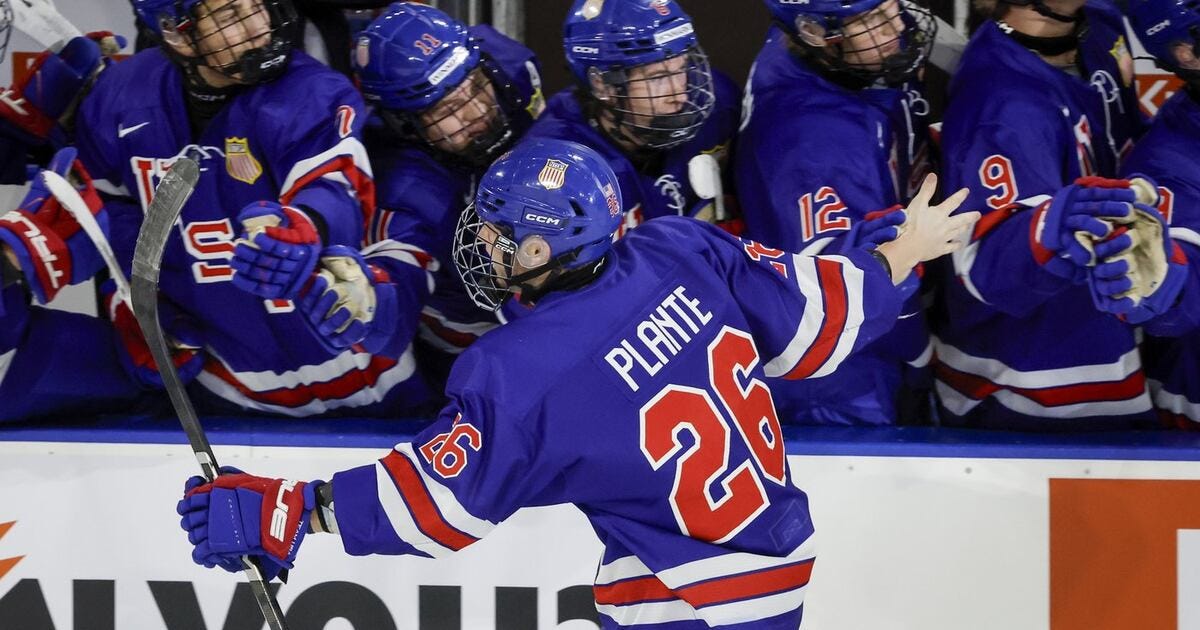
Scouting Report: Victor Plante
A closer look at Detroit's 2026 2nd round draft pick
Credit: TSN
The last time the Detroit Red Wings took a USNTDP player out of Hermantown, Minnesota in the second round, it worked out pretty well; so it didn’t come as much of a shock when they selected the third and youngest of the Plante brothers with the 47th overall pick in this summer’s draft.
Victor Plante spent this past season playing for the US National Team Development Program’s U-18 team in the USHL. This year’s version of the USNTDP under 18 squad wasn’t a vintage one, as the club finished last in the East division of the USHL, finishing only 3 points out of dead last in the entire league. They surrendered the most goals against in the USHL, giving up nearly 50 more goals than the second worst defensive team in the league. I mention this mostly due to the fact the counting stats for Plante are fairly underwhelming: 8 goals and 10 assists.
Even with that being the case, Plante tied for 3rd in points per game at 0.90. And while Plante only played in 20 USHL games — basically 1/3 of the season — he finished -1 on a team that had a -130 goal differential. Over the course of the USHL season, Plante’s worst games from a plus/minus standpoint was a -2, which happened on two occasions. He was clearly sheltered when it came to ice time, but that’s still respectable.
To his credit, Victor Plante typically wasn’t at the scene of the crime when the team needed to fish the puck out of their own goal.
The Red Wings were quite familiar with Victor, and it’s not just due to having drafted his brother Max: the youngest Plante brother billeted with Chris Osgood’s family. When Helene St James asked Ozzie to give a scouting report on Victor’s game, he kept the expectations very modest:
When you watch him, he's always in the right spot. I don't want to compare him to Henrik Zetterberg, because Zetterberg's very smart, but kind of like that. I don't want to get expectations that high, but like a Zetterberg or Patrice Bergeron-type smart player.
No pressure, Victor.
Plante will join his two older brothers Max and Zam at the University of Minnesota-Duluth this fall on a team with a great shot at making its second straight Frozen Four, which has to feel pretty great after this past season. The upcoming 2026-27 NCAA campaign will give us some insight into how Victor’s talent compares to his two older brothers.
Victor Plante’s Career Stats
Credit: Elite Prospects
For this scouting report, I’ve reviewed the USNTDP’s 5-3 win over the Muskegon Lumberjacks on March 27th. That Muskegon team finished 5th in the Eastern division and had an impressive playoff run before losing in the USHL Finals. One of the main reasons I decided to use this game was due to Victor Plante making it onto the scoresheet with an assist and it was a game against a quality opponent.
Victor Plante’s Position and Playing Style
Victor was stationed on the right wing, and received a decent amount of time on the power play. When on the power play, Plante tends to hang out down low near the goal, either going to the front of the net or stationing himself to the side of the net in order to be a facilitator, often attempting to center the puck to a teammate in the slot for a one-timer.
Plante was not used at all on the PK. His linemates were Logan Stuart (Washington Capitals 7th round pick), Jamie Glance (2027 draft class), and he often played with d-men Abe Barnett (2027 draft class, will play in the OHL next season before heading to the University of Michigan with JP Hurlbert), and Luke Schairer (St Louis Blues 3rd round pick). Stuart was injured during the second period so center Sammy Nelson was double-shifted and played on the Plante and Glance line.
Plante’s line did not drive the bus: the top line featured first round draft pick Wyatt Cullen along with Mikey Berchild (Carolina, 4th round) and Dayne Beuker. The other primary line included Parker Trottier (Montreal, 6th round), Casey Mutryn (Seattle, 2nd round) and the aforementioned Sammy Nelson (2027 draft class).
By my count, Plante received 5 or 6 shifts per period. With that being said, let’s take a look at his overall player rating for this game.
Victor Plante Player Ratings
Skating: 7/10
Plante’s skating seems perfectly fine. The main thing I am looking at is whether a prospect’s skating holds them back in any aspect of play, and this was definitely not the case with Victor: he was a capable forechecker, able to engage the puck carrier; he generated speed entering the offensive zone to create at least one good attack at the goal with the puck on his stick; and he won his fair share of 50/50 pucks.
There was a point in the 3rd period where he seemed to turn on the jets to get across the ice, and that served to highlight how rarely his speed was a true differentiator in this game. As he enters a high-end college hockey program, there’s reason to expect his skating to become more advanced.
I saw no issues at all with his skating, and believe it will continue to improve.
Passing: 8/10
Victor is definitely a Plante brother. His older brother Max got dinged for being the assist generator on the USNTDP when he was on a line with James Hagens and Cole Eiserman, and at this point Victor is more set up than trigger guy.
He got the primary assist on the opening goal in this game, getting things started by forechecking the puck carrier in the offensive zone to force the turnover. He then received the pass off the turnover and found Jamie Glance to the side of the net for the goal.
While Plante generated 10 assists and 8 goals in 20 games for the USNTDP, he put up 1 goal and 4 assists for the US team in the World Juniors U-18 competition over 5 games. When playing with capable scorers, Victor’s vision and passing stand out.
While Plante isn’t a battler in the corners, he uses his quickness and hockey sense to win the puck before recycling it back to the point. As far as issues not related directly to passing, with roughly 11 minutes remaining in the third period, Plante tried to stick handle out of his own zone and had the puck stripped, resulting in a quality shot on goal for the Lumberjacks.
Shooting: 7/10
For the season, Plante shot 18.6%, which ranked 4th among USNTDP skaters with at least 20 games played. In this game, however, Plante’s shot was a non-factor. He had several decent scoring chances with the puck on his stick in close to the goal, but the vast majority of them were blocked, with one shot from distance easily gloved by opposing goalie Carl Axelsson.
Plante is able to consistently get himself into good scoring position, which bodes well for his future as a goal scorer. Muskegon was middle of the road in terms of goals against the USHL, so Plante only getting one shot on frame at Muskegon goaltender Carl Axelsson stood out: it may have just been an off game for him.
As we saw with his brother Max, goal scoring could certainly be a skill that develops over time. There’s also this OT goal in the Prospects Challenge from Victor which was pretty impressive:
Physical Play: 3/10
While Victor is a capable forechecker, I only noticed one time when he actually finished his check. Given his size he certainly isn’t going to be a force of nature out on the ice, but even when he was attempting to skate through contact in the neutral zone, he would typically lose possession of the puck.
Being a smaller player, he will benefit from time in a college hockey program where the focus will be on nutrition and building strength.
Board Play: 4/10
Victor relies heavily on his quickness and hockey IQ to ‘win’ board battles, getting in and moving the puck before the battle commences rather than trying to withstand physical contact. Just about every time I saw him get caught up in a board battle, he ended up losing possession. If he’s to make it as a regular NHL player, it’s certainly not going to be due to him reminding people of Carter Bear.
Defensive Play: 8/10
It’s important to keep in mind that Plante wasn’t given heavy amounts of ice time in this game, and unfortunately the USHL website doesn’t track TOI, but if it did I suspect Plante’s average minutes per game would reflect that of a middle six forward. Even with that being the case, he’s a very defensively responsible forward, dropping low in his defensive zone in order to provide support. He’s also an eager forechecker, despite his unwillingness to play the body.
He was on the ice for one goal against in this game, and during that play he dropped down to the front of the net to cover one attacker, but was walled off from where the shot came from, and as a result was unable to defend the shot.
It’s also worth reiterating that he received no penalty kill time in this game, but despite this being the case I thought his commitment to play within his own zone was of reasonably high quality.
He looks like your prototypical Red Wings prospect in this regard.
Victor Plante’s Projection
It would be unfair to Victor to compare him to his brother Max, who won the Hobey Baker last year as a sophomore and was described by the Athletic’s Max Bultman as the best player on the ice at the recent prospect development camp. However when you look at his point per game totals for the USNTDP, his point per game production for the US team at the World Juniors, and his key goal in the USA-Canada Prospects Challenge, you certainly see elements of what made his older brother Max such an exciting prospect.
With that being said, I am going to lean heavily on how Victor was used by the USNTDP this past season and project him to be a third line winger who can contribute on the power play. For me, that probably works out to something like 20 goals and 40-45 points per season. He’ll likely be a good option for overtime in the regular season when the ice opens up.
His ceiling may suggest a second line winger who has a bit more scoring punch, but I have trouble at this point envisioning him as a first line wing who can play in all situations. If he had that sort of development curve he likely would have received heavier minutes in the USHL this past season. With that being said, his play with Team USA in the World Juniors saw him tie for 2nd in assists for Team USA and tie for 4th in points per game. So chances are good he can play up the lineup and not be an anchor.
Regardless, he will step into an ideal situation this fall when he suits up with his brothers to play on a Minnesota-Duluth team that will be among the best in the nation.


