

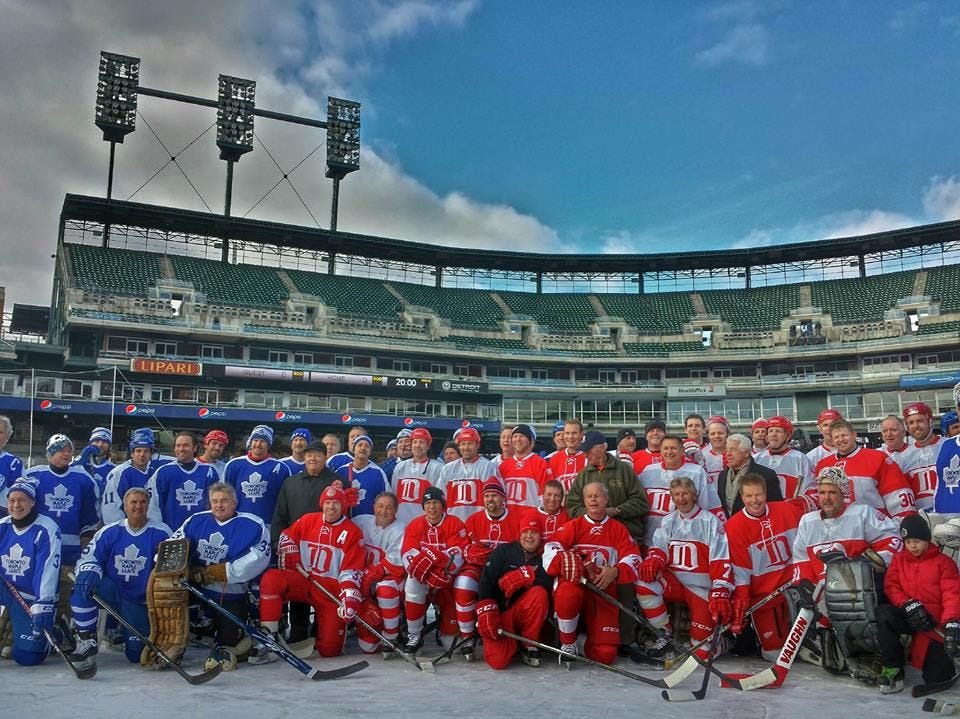
With the Red Wings preparing to celebrate their 100th season of hockey, now seems like a great time to step back into the franchise’s history to determine the greatest players to ever wear the sweater adorned with a winged wheel. With a history that spans back a century and a franchise that has won the third most Stanley Cups in league history, there are no shortage of qualified candidates - other than at right defense, but we’ll get to that shortly.
In order to come up with this list, it’s important to establish some ground rules. While you probably disagree with some of my selections, let me spell out the criteria I used when making my choices. Different criteria would likely yield several different selections.
Red Wings Centennial Team: Rules for Selection
Here are the guidelines I used to determine the players I selected:
This will be a 23 man roster. For one, this allows four extra players to be recognized, but it also creates a clear cut off line while factoring into a few other rules.
I’m only going to include one member from the teams that won Stanley Cups between 1935 and 1943. There’s simply too little available for me to make any insightful comments on their play, so I’ll leave it to others to make the case for the players who led the earliest Cup winners. This team is going to heavily feature players from the Production Line and Hockeytown eras.
The goal will be to create a real team, meaning the 4th liners are 4th liners, not 1st or 2nd liners who can’t fit on a scoring line. There are one or two exceptions here, and they are mostly on defense.
Each player has to be slotted into his actual position he played throughout his career. So no left side defenders playing right side defense.
The player has to have played a significant amount of his career in Detroit, and the Red Wings should be the team fans across the league would associate that player with. There will be none of this Colorado retires Ray Bourque’s number nonsense. So players like Brian Rafalski, Chris Chelios, Larry Murphy, Mathieu Schneider, Marcel Dionne, Brett Hull, Dominik Hašek and Luc Robitaille are ineligible.
With that out of the way, let’s get on with building our team.
Red Wings Centennial Team: The Forwards
We’ll go with 13 forwards, which fits perfectly on a team that features Pavel Datsyuk.
First Line Forwards
Left Wing: Ted Lindsay (Hall of Fame inductee)
Terrible Ted Lindsay’s size (5’8”, 160lbs) belied his impact on the ice. Lindsay played during the Original 6 era when it wasn’t a massive stretch to call the game a war on ice. A typical season for Lindsay included 30 goals, 70 points and 100 PIMs, so he wouldn’t be on anyone’s short list for the Lady Byng award. If there’s a current player who comes closest to representing Lindsay’s stature and style of play it’s Brad Marchand, but Ted Lindsay was truly one of one.
Ted has his name engraved on the Stanley Cup 4 times; he was also a 9 time All Star, and won the Art Ross award following the 1949-50 season. Lindsay is also a member of the NHL’s 100th anniversary team, which indicates he’s highly rated across the league.
Center: Steve Yzerman (Hall of Fame inductee)
Steve Yzerman was the player who spearheaded the revival of a franchise that had become known as the Dead Things. Yzerman started his career as a gifted scorer, and when all was said and done on his Hall of Fame career, he was one of the top 10 goal scorers and point producers in league history. Yzerman famously adapted his game following the arrival of Scotty Bowman as head coach. Before Taylor Swift had her eras, there was the Steve Yzerman Selke era where he was recognized as one of the best defensive forwards in the league.
Yzerman missed out on several first team All Star awards due to the simple fact he happened to play at the same time as Wayne Gretzky and Mario Lemieux. He went on to win 3 Stanley Cups, the 1997-98 Conn Smythe award as playoff MVP, and is a member of the NHL’s 100th anniversary team.
Right Wing: Gordie Howe (Hall of Fame inductee)
The undisputed greatest hockey player of all time until about 1990 when Wayne Gretzky started claiming every single one of his records. While he stood 6 foot tall, it may as well have been 6’5”, particularly if you were unlucky enough to be on the receiving end of one of his famous elbows. The original power forward, Howe would threaten 50 goals, 90 points and 80 PIMs on the regular. There was a three year stretch where he averaged just under 39 even-strength goals per year. Gordie was the man.
His accolades are as impressive as they are long: 6 time Art Ross winner, 6 time Hart trophy winner, 21 time All Star, 4 time Stanley Cup winner. He also won the WHA league trophy twice in his mid 40s. Howe is also a member of the NHL’s 100th anniversary team.
Second Line Forwards
Left Wing: Brendan Shanahan (Hall of Fame inductee)
Shanny didn’t make it to Detroit until he turned 28, but the dominant power forward of his era was one of the final pieces - along with Mike Vernon - who pushed the Red Wings from contender to Cup champion in the late 90s. While the 90s Red Wings had loads of skill, Shanahan’s combo of goal scoring combined with physical play - it wasn’t unusual for him to rack up 130 or more PIMs in a single season - helped the franchise brush aside the Avalanche during one of sport’s greatest rivalries.
Shanny won the Cup three times with Detroit and was a three-time All Star. He’s also a member of the NHL’s 100th anniversary team.
Center: Sergei Fedorov (Hall of Fame inductee)
There’s a strong case to be made that Sergei is the third greatest forward in Red Wings history, arguably behind Steve Yzerman, but undebatably behind Gordie Howe. He was the OG Pavel Datsyuk, one of the most exciting forwards in league history. Sergei had all the skill in the world, as evidenced by his Hart, Selke and Art Ross trophies. He pushed for contracts and salaries that reflected his sheer dominance, and that ultimately ended his time in Detroit. His exit played a role in his number still not being retired by the franchise, an honor his play certainly warrants.
Feds won 3 Stanley Cups, was a 1-time All Star, and is a member of the NHL’s 100th anniversary team.
Right Wing: Mud Bruneteau
Mud will be the lone selection from those early Cup winning teams. He fits the bill as he was a member of the first three Cup winning teams in franchise history. His most famous involvement in NHL history is that he ended the longest game ever by scoring the game-winning goal in the 6th overtime, as the Red Wings claimed the first game en route to sweeping Montreal in their 1936 playoff series. That team would go on to win the first championship in franchise history.
Third Line Forwards
Left Wing: Tomas Holmström
It’s important to keep in mind that while this is a list of all time greats, we want it to resemble what a successful hockey team would look like on the ice and, in the case of Homer, in the locker room as well. While the Demolition Man wasn’t an All Star, Art Ross or Hart trophy candidate, he was an elite net-front presence who could throw the best goalies in the league off their game. Over a 7 year stretch from 2005-06 to 2011-12, Holmström averaged nearly 11 power play goals per season. He also created an untold number of goals for his teammates by screening the goaltender.
While Homer was a royal PITA on the ice for opposing players, he was known in the dressing room for his ‘Homerisms’ which would keep the the mood from getting too tense, no matter the situation.
Center: Pavel Datsyuk (Hall of Fame inductee)
During the early days of the advanced stats era, there were two Red Wings who were dominant: Niklas Lidstrom and Pavel Datsuyk. Pavs has also become quite popular on You Tube, where his genius stick handling skills rack up millions of views; poor Tomáš Vokoun repeatedly ends up out on fourth street.
Datsyuk’s dazzling stick work wasn’t just limited to humbling NHL goaltenders. He was one of the best defensive forwards of his era, recognized for his defensive work by being awarded the Selke trophy three times. Pav’s best seasons were from 2005 through 2009, where he averaged 92 points and a +34 plus/minus rating.
The Magic Man won 2 Stanley Cups and was selected to the NHL’s 100th anniversary team.
Right Wing: Henrik Zetterberg
While Zetterberg was a center, he would often play with Pavel Datsyuk and Tomas Holmström, so putting him on Datsyuk’s wing, while debatable, is spiritually accurate. With this third line, I’m basically just copying and pasting Mike Babcock’s top line during the aughts, when Detroit was still one of the best teams in the league.
Hank finished second in Calder voting during his rookie year, which presaged a great career in Detroit. He would go on to win the Conn Smythe trophy during Detroit’s last Stanley Cup winning season in 2008.
Fourth Line Forwards
Left Wing: Bob Probert
Probert was the apex predator among enforcers, but don’t get it twisted: Probie could hockey. He had a career high 29 goals, 62 points and 398 PIMs in his age 22 season in Detroit. The phrase ‘give blood, fight Probie’ persists across the internet, largely as an e-commerce hustle, but some of us still remember. Probie’s ticket to the show took its toll, but it enabled players like Steve Yzerman to skate a bit more freely. Yzerman made his feelings for Probert perfectly clear when it came time to say goodbye.
While the league has taken steps to move away from the game’s violent past, Mickey Redmond has said on more than one occasion to the TV audience - with an implied wink while a skirmish takes place and the fans roar their approval - “the fans sure don’t like fighting, do they?”
Center: Kris Draper
When Scotty Bowman was coach, there were times when he’d want to set the tone for a game. This would often occur during the playoffs, and in those games he’d send the Grind Line out to take the opening face-off. Buckle up, and say goodbye to open ice. Kris Draper was the longest serving member of the Grind Line, with his most common linemate over those years being Kirk Maltby.
Draper’s speed made him the perfect pivot for a checking line and the penalty kill, and he was highly successful in the face-off dot. In 2004 he was acknowledged for his defensive play when he was awarded the Selke trophy. Draper was a member of all 4 teams that won the Stanley Cup during the Hockeytown era.
Right Wing: Darren McCarty
For the final member of the 4th line, we have to go with Darren McCarty. There are two main reason he gets the nod over Kirk Maltby. The first was the fight against Claude Lemieux that all but announced the Red Wings had put an end to Colorado’s domination in the rivalry. The other reason is McCarty providing the icing on the cake for that first Cup lift in 42 years.
While D-Mac was never an All Star and will never get the call to announce he’s been welcomed into the Hall of Fame, he’s a 4-time Cup winner and is beloved by the fans.
13th Forward
Center: Alex Delvecchio (Hall of Fame inductee)
If not for Detroit’s absurd depth at center - every single pivot listed for the top three lines is a Hall of Famer and made the NHL 100th Anniversary team - Fats would be in the opening lineup. A member of Detroit’s great teams from the 1950s, Delvecchio was the mild mannered one, winning the Lady Byng trophy three times. While Delvechio didn’t have a single season where his point total would turn heads, his consistency in churning out 60ish point seasons with rock solid defensive play was impressive. From the 1957-58 through 1972-73 seasons, Fats averaged 63 points per year. He had a career best 83 points and +42 plus/minus rating along with a Lady Byng win during his age 36 season.
Delvecchio won 3 Stanley Cups, was a 2-time All Star, and is a member of the NHL’s 100th anniversary team.
Red Wings Centennial Team: The Defenders
We’ll go with 8 defenders, and I’ll say in advance the right side is…interesting.
First Pairing Defenders
Left Defense: Nick Lidstrom (Hall of Fame inductee)
Widely regarded as one of the top three greatest defenders of all time, the Perfect Human amassed 1,142 career points and an eye popping +450 plus/minus while going up against the best talent the league had to offer from 1991 to 2012. Lidstrom was a 7-time Norris winner and you could make the case he should have won a few more. Lidstrom wouldn’t run you through the boards; no, his MO was to strip you of the puck and headman it with a perfect tape to tape pass to send a forward in all alone on the opposing goal. The league eventually grew to appreciate his style of defending.
His list of accolades is nearly as long as Gordie’s: 4 time Cup winner, Conn Smythe winner, 12 time All Star, the aforementioned 7 Norris wins, and of course he’s a member of the NHL’s 100th anniversary team.
Right Defense: Reed Larson
Reed Larson benefited from playing during the open era when NHL scoring was at its apex, but he still holds 9 of the top 10 spots for highest scoring seasons from a right shooting defender in franchise history. Plus, you could put a traffic cone on the ice as Lidstrom’s partner and that orange cone would rank top 10 among all NHL defenders in every key advanced stat. We’re not putting Brian Rafalski here because he’s best known for his years with the Devils, and Cheli doesn’t fit due to him being known primarily as a Blackhawk.
Larson did receive some acknowledgement for his play across the league, finishing 5th in Calder voting the year Mike Bossy won the award, had several decent showings in All Star voting; he even finished as high as 8th place for Norris voting. So that makes him the best right side defender for this top pairing - at least for now.
Second Pairing Defenders
Left Defense: Red Kelly (Hall of Fame inductee)
If you judge players simply by the number of titles they’ve won, you can’t do much better than Red Kelly, who won 8 Stanley Cup championships. Red made a name for himself in Detroit as a defender after a Toronto scout said he wouldn’t last 20 games in the league. Red would eventually go on to play center for the Maple Leafs after a long career as a Red Wing, but Kelly was an NHL All Star in a span of 6 out of 7 seasons during his time in Detroit. He won three Byng trophies as a Red Wing but only one in Toronto. Simply put, Red’s best years were in Detroit.
Kelly won the Norris trophy for the 1953-54 season and was part of 4 Stanley Cup winning teams in Detroit. He’s also a member of the NHL’s 100th anniversary team.
Right Defense: Vladimir Konstantinov
With Vlad the Impaler, the question is what might have been? His career was cut short just as he was entering his prime: he had an absurd +60 plus/minus in 1995-96 and finished 4th and 2nd in Norris trophy voting before the limousine accident that stole his career. Like Gordie, Vlad played much bigger than his size. He was the quintessential shut down defender who would rack up the hits and PIMs, but could also score: Konstantinov had 12 and 14 goal seasons.
Third Pairing Defenders
Left Defense: Marcel Pronovost (Hall of Fame inductee)
Marcel played the bulk of his career in Detroit, racking up 5 top-five Norris trophy finishes during his time as a Red Wing. Always eager to join the rush, Pronovost was considered Detroit’s Flying Frenchman. He was an alternate captain who was named to 4 All Star teams.
Pronovost made 8 appearances in the Stanley Cup Finals for Detroit, winning four of them.
Right Defense: Bob Goldham
Golden Boy played 6 seasons as a Red Wing. While he was on two Cup-winning teams in Toronto at the start of his career, he was not a key member of those teams, playing 19 and 11 games in each of those seasons. As a member of the Red Wings, he never played fewer than 61 games and finished 4th in Norris voting in 1955. Goldman was called a second goalie due to the way he’d throw his 6’2” body in front of shots.
Goldham was a key member of three Stanley Cup winning teams in Detroit.
Depth Defenders
We’ll add on two depth defenders to help us fill out our 23 man roster.
Left Defense: Niklas Kronwall
Kronner was a key member of the Red Wings throughout the aughts, delivering vicious open ice hits while running Detroit’s second power play unit. Kronwall was at his best as a second pairing defender, and had his greatest success when paired with Brad Stuart, another right defenseman the Red Wings acquired via trade.
Right Defense: Moritz Seider
The lone current member of the Red Wings, Seider’s inclusion is due in large part to the franchise relying so heavily on right side defenders who were acquired from other organizations. Even with that being the case, Mo’s career has gotten off to a fine start, winning the Calder trophy in 2022. Seider has routinely been called on to play some of the toughest minutes in the league, gets a boatload of short-handed minutes, and features on Detroit’s highly-successful power play.
It’s not difficult to see Mo moving up the lineup in future versions of this team.
Red Wings Centennial Team: The Goaltenders
No, we’re not including Dom. One starter, one backup.
Starting Goalie
Terry Sawchuk (Hall of Fame inductee)
Like Gordie, Sawchuk was long considered the greatest of all time before players like Martin Brodeur and Patrick Roy chipped away at all of his records. Terry quickly established himself as the greatest to ever play the game, winning the Calder during his age 21 season while also being named to the All Star team. He would go on to win the Vezina trophy in three of the next four seasons. Ukey would earn top four Hart trophy votes in 3 of his first 9 professional seasons. When he retired he held every significant goalie record.
Sawchuk backstopped the Red Wings to three Stanley Cup victories over a five year period, was a 7-time All Star, won 4 Vezina trophies, and is a member of the NHL’s 100th anniversary team.
Backup Goalie
The margin likely preventing Chris Osgood from making the Hall of Fame is one goal, that being in Game 7 of the 2009 NHL Finals. If that game goes to overtime, there’s a decent chance Detroit wins the series and if that was to happen, there’s a strong case for Osgood winning the Conn Smythe. It simply wasn’t meant to be, but a Conn Smythe win goes a long way towards clinching Osgood’s entry to the Hall of Fame.
400 regular season wins, 74 playoff wins, .930 and .926 playoff save percentages in 2008 and 2009 when called into action due to Dom Hašek’s career coming to an end; add in a Conn Smythe and you could make the case for Osgood getting that call.
Early in his career, Osgood was considered the beneficiary of a dominant Red Wings team. His case wasn’t helped by the fact the team needed to trade for Mike Vernon to get that first Cup win in 42 years. But Osgood remained a Red Wing, with a short detour to Long Island and then St Louis. He also refined his technique, and it paid dividends towards the tail end of his career when he had two of his better seasons.
Ozzie won three Stanley Cups and was part of a tandem in goal that won two Jennings awards.