Red Wings 2026 NHL Draft Primer
Can Detroit find an impact player in the second round and beyond?
Credit: Detroit Hockey Insider
For the first time since Ken Holland was general manager, the Detroit Red Wings do not have a pick in the first round of this weekend’s NHL draft. While they lost their first rounder to St Louis as part of the Justin Faulk trade, there’s certainly a possibility of them gaining a first as part of a Dylan Larkin trade package. However we have no insight on that front, so I’m going to stick with the picks the Red Wings currently own, and provide some names and overviews of players who may be available when it comes time for Steve Yzerman and crew to make their selection.
Draft Needs and Philosophy
Generally speaking, you want to select the best player available, however when you get further down the draft, that’s not always easy to suss out. So rather than try to rank every single player, I am going to focus on team needs and try to identify players who could potentially fill a need and are expected to be available when Detroit makes their selection.
The biggest need by far is a scoring line center, and good luck finding one of those with the 47th overall pick. Of course Yzerman’s amateur scouting team did just that back when he was running the Tampa Bay Lightning organization, as they selected Brayden Point in the third round of the 2014 draft. The small center has four 80+ point seasons in his career, with a season’s best of 95 points and 51 goals.
The Red Wings, it goes without saying, could certainly use a prospect of Point’s caliber.
Detroit should also focus on continuing to add skill to their top 6 generally, so if there isn’t a center they like it would make sense to target a winger. The Red Wings drafted Max Plante with the 47th overall pick back in 2024 and he went on to win the Hobey Baker award as a sophomore. Go back three more drafts and you will find Logan Stankoven taken 47th overall. When Stankoven arrived in Carolina they converted him to center, which was truly a case of winner, winner, chicken dinner.
Obviously, the odds of finding this sort of diamond in the rough at forward aren’t fantastic, but they do pop up from time to time. One more example: Columbus selected Kirill Marchenko with the 49th overall pick in the 2018 draft.
If there isn’t a skilled center or winger you like in that 47th overall spot, it would likely make sense to target a defender who could blossom into a top 4 role. Brock Faber, Kevin Bahl, Drew Helleson, JJ Moser, Lane Hutson, and Albet Johansson were all selected in the second round, and — generally speaking — the odds of finding a good defender in the second round are better than finding a scoring line forward; all you have the do is look across the league at the very strong representation of good NHL defenders who were not first round draft picks.
It’s definitely a thing.
The biggest skill I would look for is a player who is capable of dishing the biscuit, as the Red Wings don’t have much in the way of premium assist generators. The good news is the players Steve Yzerman should be building around — Lucas Raymond and Mortiz Seider — were both top 30 assist generators in the league. Alex DeBrincat — who I’d definitely have time for on a contract extension in the D — was top 45.
So yeah, Detroit has a massive need for a center who can make sure his linemates eat.
With that being the case, a center would be my strong preference, but if there aren’t any you like, look instead for a winger or defender who can churn out the apples.
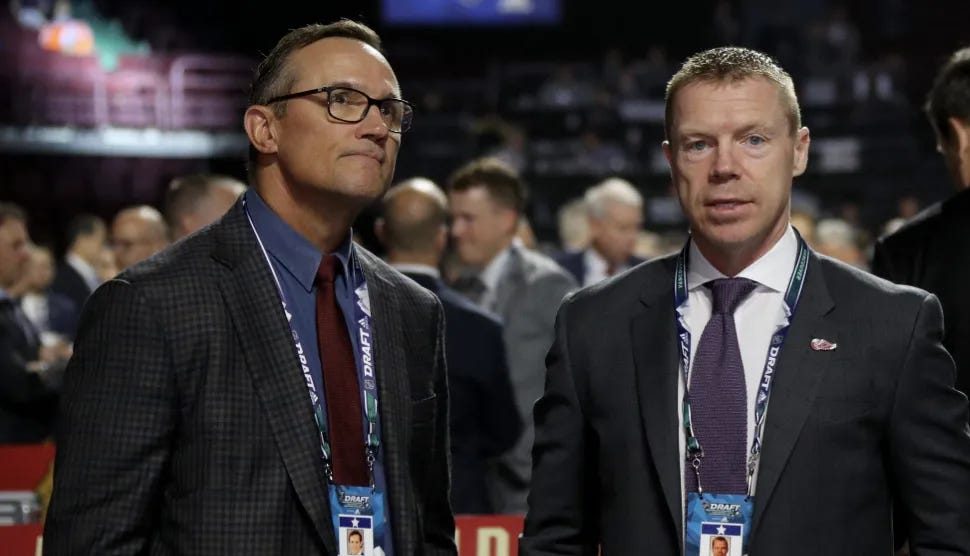
Time to get down to business: let’s take a look at some players who may be available when Steve Yzerman and Kris Draper make their selections.
Second Round, 47th Overall
I’M LEGIT INTRIGUED! Options
Credit: Michigan Daily
Adam Valentini, Forward, Michigan (NCAA)
Ranking Range: early 40s
If Adam Valentini was a couple inches taller he’d likely be a first round pick. He has everything pro scouts value, well, other than size. The only reason he may be available in the second round is due to the fact he’s a shade under 5’10”.
Then there’s the fact Valentini bounced on a commitment to play for Kitchener at the last minute — which may sour some organizations on him — but he left Kitchener to play for an NCAA program that churns out more NHL talent than just about any amateur hockey team in North America. So while there may be some bitter feelings in some scouting organizations, Valentini performed very well at Michigan as a guy who only turned 18 in April.
I’ve seen Valentini play a decent amount this past season and I think there’s a really good chance he’s a much more skilled Dylan Duke. While Duke put up 0.46 points per game in his freshman season in Ann Arbor, Valentini put up 0.68.
Valentini led all 17 year old players in the NCAA in goals, assists, points, and points per game. He’s also got some bite to his game: Elite Prospects’ JD Burke commented on Valentini’s physical play, stating:
Valentini played the body with as much vigor as ever at both ends of the ice, enthusiastically thew himself in and out of shooting lanes to block shots, and broke up plays with an active stick.
Burke continued on in another scouting report: ‘…checked all the usual boxes, hounding down opponents in all three zones and plastering them to the boards with thunderous shoulder checks.’
Valentini’s coach at Michigan called him ‘an absolute dawg’. If there’s another thing Detroit sorely needs beyond assist generating pivots, it’s dawgs.
Elite Prospects’ David St-Louis thinks Valentini can be a secondary play driver based on what he saw when Canada played Sweden in the U18 World Juniors. At the U18s, Valentini finished just outside the top 10 in goals scored and points per game for the tournament. So while he’s not a top end scorer, he knows how to contribute in the o-zone.
Then there’s the fact Michigan under Brandon Naurato has done a fine job developing players like Valentini. TJ Hughes, an undrafted forward, finished 2nd in the NCAA in points and 3rd in assists this past season before signing as an unrestricted free agent with the Avalanche organization. The aforementioned Dylan Duke, who was drafted in the fourth round by Tampa, finished 11th in the NCAA in point production in the 2023-24 season.
TJ Hughes was a bit of a unique case for Michigan, as he was 24 last season, but there’s no reason Valentini can’t produce at Hughes’ or Duke’s level, with a strong likelihood of surpassing both of them before his time in Ann Arbor is over.
With all that being said. there’s a good chance he’ll be gone by the time Detroit drafts. He’s going to be very popular with many scouting staffs, as his game is highly transferable to the NHL.
Projected Role:
Michigan does a good job developing forwards, and it wouldn’t shock me if Valentini turns into a middle six forward who can play in all situations.
Yegor Shilov, Forward, Victoriaville Tigers (QMJHL)
Ranking Range: late 20s
The only reason I’m listing Shilov here is because the Athletic mock draft has him going 51st overall to the Calgary Flames. Looking at where he’s rated across most major scouting services, he’ll almost certainly be gone before then, most likely by the end of the first round based on those projections.
If Shilov was to drop out of the first round, it’s due to the fact he plays in the Quebec Maritime Junior Hockey League, a league that gets dinged for its lack of defensive polish (there ain’t no D in QMJHL, that sort of thing). So his skill may be overstated, while his pace and physical play are considered highly sus.
With that being said, there’s a lot to like about Shilov. For starters, he was the leading point producers among 17 year old players in the Q. And while he can bury the biscuit, he also led all 17 year olds in the number of helpers he dished out. He finished 7th among all skaters in the Q in total points, and 12th in points per game (minimum of 40 games played).
The bottom line for me is Detroit badly needs a center who can distribute the puck, so Shilov would be an intriguing prospect should he fall outside the top 50 as predicted by the Athletic mock draft.
Elite Prospects’ Cam Robinson does a nice job summing up Shilov’s strengths:
Everything slows down when puck gets on his stick. He manipulates pressure really naturally with delays, cutbacks, shoulder fakes, and little changes in pace and angle that pull defenders out of lanes…repeatedly baiting [defenders] toward him before slipping pucks under sticks, or between his legs and into soft areas for a teammate to walk into…the offensive brain is high-end. There’s real upside here if the pace and physical side continue to develop.
While I’m skeptical he’ll fall out of the top 50, the lack of a consistent motor and poor level of physical engagement may result in Shilov dropping down most teams’ draft boards. Elite Prospects’ David St-Louis believes his upside would skyrocket if he was capable of improving his level of play from shift to shift, suggesting he has a shot — albeit a long one — of turning into a top six player in the NHL.
Shilov is headed to Penn State for college, so he’ll get to show his stuff in one of the premier college hockey leagues, which again makes him an intriguing prospect. I think college hockey will do him well, as the Nittany Lions program will allow him to embrace his creativity while spamming shots, hopefully with a healthy dose of encouragement to focus on improving his strength and compete level.
Projected Role:
Anywhere from AHL All Star to scoring line play driver in the NHL. I find it hard to believe he’ll still be on the board this late. If he drops to Detroit he’d in theory be exactly what the Red Wings need in their prospect pool, particularly if he can hang at center rather than wing.
Alexander Bilecki, Left Defense, Kitchener (OHL)
Ranking Range: mid 40s
If there’s a team that falls in love with Alexander Bilecki’s potential, there’s a good chance he’s gone by the time Detroit makes their first pick, but I hope not as he’s the sort of highly skilled guy I’d like to see the Red Wings take a flyer on should he somehow slip past pick #46. The more well known scouts like Button and Pronman have him in Detroit’s range, so there’s a shot Bilecki could slip under the radar, as he didn’t get big minutes with Kitchener this past season.
Even with that being the case, Bilecki finished the OHL season as the 6th highest point producer and points per game among 17 and under rear guards (minimum of 40 games played). He led all such defenders in total points during the playoffs, edged out only by Andrew Robinson by 0.01 in points per game during post season play. So he maintained his high level when the games started to matter.
Daniel Gee from Elite Prospects was quite impressed with Bilecki’s offensive potential in an April scouting report, writing:
Bilecki’s playmaking and activation looked special in moments. He doesn’t play much, but you get the sense that with some more opportunity, he may be one of the most talented offensive defenders available. He could be a top 4 defender if he rounds out his game.
Bilecki has been described at times as a fourth forward on the ice, which has its benefits and drawbacks, but with the NHL once again embracing pace pushing, highly skilled rearguards, Bilecki checks off each of those attributes. My guess is he’ll have a breakout campaign next season.
Lauren Kelly from EP suggested Bilecki has top 64 potential regarding his draft position, indicating opinions are still quite mixed on him. For my money, Detroit needs skill and Bilecki has the potential to unleash the sort of passing a team like Detroit will need given the lack of playmaking centers in the system.
Projected Role:
Bottom three offensive defenseman and 2nd power play QB
Samu Alalauri, Right Defense, Pelicans U20 (Finland)
Ranking Range: late 40s
I’m not in love with his game, but I am kinda intrigued by Samu Alalauri as he seems to have a lot of projectable traits which could land him on an NHL roster. David St-Louis from Elite Prospects highlights the foundational skills that could lead to Samu Alalauri becoming a quality NHL rearguard:
The skating ability, activations, physical game, and aggressiveness form a solid NHL base.
-April 29, 2026 (WJC-18 vs Czechia)
The thing that gives me reservations is the fact Alalauri’s game can break down badly when facing top competition — for instance the game against Canada’s U18 squad — so that’s definitely a concern, but it could just be a matter of better understanding how to adjust the patience with the puck sliders based on opponent. His skill was on full display against Slovakia’s U18 team when he put up a goal and two assists. EP’s JD Burke liked what he saw:
There’s a high level of risk tolerance there and the occasional turnover resulting from it, but Alalauri plans every touch, has obvious puck skills, can move opponents from his path with deception and fakes, and perhaps most appreciably in this game, has such a great sense of patience.
-April 25, 2026 (WJC-18 vs Slovakia)
To me, that says there may be some legit concerns when it comes to hockey sense. Alalauri isn’t my top pick here, but if Håkan Andersson and his crew of Euro scouts like the Finnish rearguard, well that would be good enough for me.
Among 18 and under defenders, Alalauri had the third highest assist total, tied for the third highest points per game, and had the fourth highest goals and points per game (minimum of 30 games played) in the U20 SM-sarja, which is a good sign for a defender who turned 18 late last month.
While playing for Pelicans U20, Alalauri was regularly playing 20 minutes per night, and there were occasions where he was playing 25 or more. He had a solid +19 on a team that was +52 for the season. The big question is what his game looks like once the quality of competition goes on a steep upward trajectory?
At the WJC18, Alalauri was top 10 across the entire competition for assists, points and points per game. He was third overall for all Team Finland skaters for point production with only two Finnish forwards putting up higher point totals. Outside of a 7-0 shellacking at the hands of Canada, Alalauri was routinely playing 22+ minutes per night for the Finland U18 team.
Elite Prospects thinks he has enough game for Alalauri to develop into a top 4 defender. He has great size at 6’2” and 220 lbs, and he’ll continue his development next fall at the University of Massachusetts.
Projected Role:
Potential to develop into a bottom 3 defender.
EWW, F&*k NAW! Options
Mathis Preston, Right Wing, Vancouver Giants (WHL)
Ranking Range: early 30s
The Athletic’s staff lists Preston as Detroit’s pick, so I’m going to include him in this article despite the fact most scouts rank him right around the top 30, well before Detroit will make their first selection. Also, to be candid, I don’t love his draft profile and hope Detroit will go in another direction with this pick.
Looking at his scoring across the WHL among all 17 and under skaters, Preston finished 23rd, likely suppressed by the fact he played most of the season on a bad Spokane team. Once he was moved to Vancouver, he saw his point per game totals skyrocket from 0.89 points per game to 1.20. So that’s encouraging and likely helped boost his draft stock. If he averaged 1.20 PPG for the entire season, that would land him in the top 10 ahead of 2027 super prospect Landon Dupont.
It’s worth pointing out however that this projection is based on a flimsy sample of 10 games. I’m not a fan of extrapolating from small sample sizes, but I want to be fair to Preston.
Preston is considered one of the fastest skaters in this draft class, and has the type of shot that could give him an outside chance at featuring on a scoring line. The major problem is he struggles to link up with his teammates, suggesting he lacks hockey sense.
He’s drawn some comparisons to JJ Peterka which sounds great, but a lot is being made out of his performance in international tournaments where he was surrounded by elite talent. We saw the same thing happen last year with Brady Martin who was a draft day riser based on international tournaments but had an off year this past season.
For me, I’m just not excited about the prospect of drafting Preston, due mostly to the fact he seems like a ‘one weird trick’ prospect where his speed and shot, which work fairly well at lower levels, may be less effective against better competition.
Daniel Gee’s writeup for Elite Prospects sums this up rather well:
He hope passes quite a bit, mostly from the outside, throwing pucks through the crease in the hope that a crasher or weakside option picks up the puck.
He hangs onto pucks too long, misses better options, and forces far too much, often outside the dotted lines.
That screams lack of hockey sense, and what Detroit really needs is skill combined with hockey sense. I just don’t see the fit here. The quotes EP has from NHL scouts are also really concerning, with the only positive trait listed is his skating. That’s just not enough for me, particularly when there are likely to be other players who are better fits and should be available when Detroit makes their pick.
Projected Role:
Anywhere from AHL player to middle six contributor in the NHL. Hopefully there’s enough speed and skill on the highlight tape to entice a team to select him before pick #47. The NHL is a copycat league and Carolina is a team that relies on guys who can flat out fly.
Niklas Aaram-Olsen, Right Wing, Örebro (Sweden)
Ranking Range: late 30s
Like countryman Michael Brandsegg-Nygård, Aaram-Olsen has a pro caliber shot, which may make him an intriguing option should he slip to Detroit at 47. While he doesn’t have MBN’s physical edge, he’s the better skater, and projects to be a power play contributor who if you are lucky can provide some depth scoring further down the lineup.
For the U20 league in Sweden, NAO — I guess that’s what we’ll him — was 5th in total points, 8th in assists, and 3rd in points per game while appearing in 29 games for Örebero.
Detroit — with the expected departure of Dylan Larkin — doesn’t have playmaking centers, so the concern is who will be able to get NAO the puck so he can do his thing? Janik Beichler highlighted this issue in the EP write up for Norway’s WJC game against Latvia:
Aaram-Olsen has never been much of a play driver, so not having anyone to do that part for him was expected to become an issue…[and] it became a big one. Aaram-Olsen did show his speed, handling skill, and passing, but he couldn’t create much and doesn’t have much of a B game.
EP’s Lassi Alanen’s write up highlights how NAO generates offense and why Detroit as currently constructed may not be the best fit:
Aaram-Olsen remains at heart of Örebro’s top power play unit. His teammates are trying to provide him with one-timer opportunities, whether through cross-slot passes or Aaram-Olsen circling and trying to time his downhill moves so he can get shooting looks off strong-side passes.
He has the shot and the skating going for him, but the lack of teammate utilization and playmaking output is worrying.
The good news is NAO was on Örebro’s SHL roster for 16 games; the bad news is his butt was firmly plastered to the bench, which suggests the coach did not trust him. For many of those games he got no ice time, with a season high of 10 minutes in one contest and one contest only. In games where he got ice time, it was something like 3 minutes.
Aaram-Olsen has one clear NHL skill as a quality trigger man, however I’d prefer to see Steve Yzerman and crew try their luck with a more dynamic playmaker with their first pick in the draft. As such, I view NAO as a tweener, probably not a fit at 47, but likely gone by the time Detroit makes their next selection at 79.
Projected Role:
Third line winger who thrives on the power play
Ryan Roobroeck, Left Wing, Niagara Ice Dogs (OHL)
Ranking Range: mid 40s
The big concern with Ryan Roobroeck is the compete level. While it’s unlikely you are going to be able fill out a lineup with maximum amounts of skill and compete, Roobroeck has taken a tumble down the rankings due to what has been viewed as ineffectual play. Being 6’4”, the lack of physical play can be absolutely maddening. But Roobroeck’s rankings, his skill, and his size may prove too much for Detroit to pass on.
He’s also one of the older players in this draft as he’s a September 2007 birthday, so he was 18 when the season started. With a guy at that end of the spectrum, you are hoping for a more polished product, but unfortunately that’s not the case with Roobroeck.
He finished outside the top 40 in point production in the OHL, outside the top 20 in goals scored, and outside the top 70 in assists. Among players with at least 40 games played, he was 22nd in points per game. The assist totals are the thing that really stand out and make me wonder whether he can hang at center in pro hockey? On the plus side, it looks like 20 of his 30 goals came at even-strength. That’s an admittedly good sign.
The EP scouting reports give off some heavy Anthony Mantha vibes. Here’s the most recent one from Lauren Kelly:
He’s…spending long stretches floating without really impacting play. He’s one of the trickier projections in this class -- he’s a top-10 player in terms of skill, and he has game-breaking ability. It just hasn’t emerged often enough this season to keep him in that range on draft boards…
EP’s David St-Louis offered up more of the same, saying back in January ‘it’s getting late in the season for him to show something’. Cam Robinson commented on a November contest featuring Team CHL against the USNTDP U18 team that ‘…with his amount of skill, it’s difficult to come away impressed when he’s not engaged and moving his feet enough.’
I am deeply conflicted on Roobroeck, as on the one hand he’s shown flashes of what Detroit needs, however the only reason he may be available is due to his play not meeting expectations. I cannot get Todd McLellan calling several of his players ‘just jerseys’ out of my mind when considering Roobroeck.
Scott Wheeler’s ranking does give me pause when it comes to my inclination to pass on Roobroeck should he be available, but Pronman and Button burying him leads me to believe Detroit should pass on him.
Projected Role:
Middle six winger who thrives with the man advantage.
Depth Picks: 79th, 143rd, 175th, 196th & 207th
Matias Vanhanen, Forward, Everett (WHL)
Ranking Range: mid 50s
I saw a fair amount of Vanhanen while watching Red Wings prospect Carter Bear this past season, and both Vanhanen and Seattle draft pick Julius Miettinen really stood out. Vanhanen generated the second highest assist total in the WHL, and while I like his game, I think selecting the over-ager with the 47th overall pick would be a bit of a reach. Odds are good he’ll be gone before Detroit makes their second round selection, but that will depend on an organization valuing him higher than the general consensus among scouts.
EP’s Mitchell Brown provides a good overview of Vanhanen’s strengths when writing up a scouting report for a March game against Penticton:
He hardly needs the puck to create offence, instantly finding teammates off the reception. He leaves pucks in space, taps them through traffic to a teammate, and slips them under sticks. Non-stop scanning and perfect touch. While he’s not overly physical, he’s a real worker, which couples with his quick-possession style. Creates a lot of turnovers as the F3, supporting, anticipating, and jumping into lanes.
Brown views him as a mid round pick, so if he’s still available when Detroit makes pick #79 I would absolutely consider taking him there.
Projected Role:
Vanhanen projects to be a bottom six winger who can contribute in all phases of the game.
Måns Gudmundsson, Right Defense, Färjestad BK (Sweden)
Ranking Range: early 60s
Gundmondsson is considered one of the bigger risers in this draft class and performed well for Tre Kronor at the World Juniors. He’s also one of the younger players in this draft class, having turned 18 on June 9.
When reading up on him, he shares some characteristics with Anton Johansson in terms of rock solid physical play. Elite Prospects’ David St-Louis was impressed with Gudmundsson’s play against Canada in the WJC-18:
Måns Gudmundsson has NHL tools and the physical game to back them up. Those elements could carry him far in his career. He finished checks, engaged opponents on the wall, pushed them off the puck, and walled off attackers as they arrived at his blue line, using his stature and long reach.
While St-Louis questioned Gudmundsson’s puck carrying ability, fellow EP scout Jimmy Hamrin was more impressed with the bits of skating and skill the Swedish defender displayed in this game, writing:
Gudmundsson could be the Swede that has strengthened his draft stock the most in the tournament as I see it. He is a puck-mover with good size that also defends well and has shown during the season to be a good power play blueliner as well. He doesn’t show high-end skills but the steadiness on both sides of the puck makes him a strong bottom-pair prospect with a chance of becoming a number four defenseman as well.
For whatever it’s worth, the Athletic mocked him to Philadelphia with the 32nd pick, so he may be off the board by the time the Red Wings make their selection.
The only reason I view him as possibly falling to #79 is due to Wheeler and Button not ranking him, but Pronman talks to enough people in the league to likely have a good handle on where Måns will go in the draft.
Projected Role:
At this point you’re hoping for a bottom pairing d-man, but there may be some untapped upside.
Adam Andersson, Center, Leksands IF (Sweden)
Ranking Range: mid 50s
Andersson should be available in this range, as he’s generally ranked in the mid 50s, and he checks off a few boxes I think would be appealing to Detroit’s amateur scouting team. For starters, he’s played in the Leksands IF organization defensive prospect Anton Johansson just matriculated through, so they should be quite familiar with his game.
He also has great size at 6’ 3.75” and is praised for his physical play. He was also considered one of the leaders for Sweden during the U18 World Juniors tournament. Andersson also has a polished game on the defensive side of the puck, and with his size and weight (215 lbs), he fits what Detroit’s scouts tend to prioritize.
David St-Louis’ scouting report in the WJC-18 game against Canada suggests you should keep your expectations fairly modest, writing:
He can’t take players one-on-one, is not really a scoring threat, and his skating will have to improve, but his checking, physical, and playmaking game are sufficiently developed to make him an attractive target in the top-70. A potential fourth-line forechecker.
For me, Andersson may be in the running with the 79th overall pick if he’s still on the board at that time.
Projected Role:
Yet another bottom six defensive center who can kill penalties
Axel Elofsson, Right Defense, Örebro HK (Sweden)
Ranking Range: 50-74
Old heads will remember Adam Almqvist, a diminutive rearguard from Sweden whom the Red Wings drafted in the 7th round way back in 2009. Almqvist had the hockey sense and the puck skills to pay the bills, but his skating was crash out bad.
After putting up 34 points on a Calder Cup winning Grand Rapids team in 2012-13 and an impressive 53 point campaign the following year, Almqvist got all of 2 games in the show before his North American career came to an end, the proverbial cup of coffee.
Axel is another 5’10’ish rearguard who oozes hockey sense and skill. The issue with these small defenders, is that the finest of margins can separate the truly elite from the guys who will never get so much as a shot of espresso in the show; given Elofsson is hanging around the low-100s in this prospect class, he’s almost surely the latter.
With that being said, I really like Detroit’s depth on defense, and I have time for defenders with either the 47th or 79th pick; I’m also generally fine with smaller players so long as they play with pace and gusto. Elofsson is that dude, with EP proclaiming him the most talented offensive defenseman in this European class, and doubling down by stating it’s not even close. While that may say more about this class of defenders out of Europe, EP wasn’t quite finished with the Axel Elofsson glazing;
Already having put together one of the most productive U17 seasons at the Swedish U20 level, Elofsson followed it up by averaging 1.28 points per game with Örebro’s stacked top junior squad, more than any draft-eligible defenceman has managed over the course of a full season.
He had his ups and downs internationally, but was unstoppable at his best and still finished with a whopping 30 points in 27 games for Sweden’s U18 program.
So, say we are in round five, where it’s incredibly difficult to find guys with a discernible talent that will land them on an NHL roster. If Axel is there, why not select him and see what his development path looks like? He’s probably another Ryan Sproul, a guy who won the OHL defender of the year award, but was never able to figure out the defensive aspects of being a defender, which is kinda important.
But sometimes ya gotta YOLO, and Axel Elofsson is about as YOLO as it gets.
Dude dominated the U20 Nationell among 17 and under players, nearly doubling up the point total of his nearest competition (Måns Gundmundsson). Axel’s 9 goals also nearly doubled his nearest competition. He also put up a league best 32 assists, 1.28 PPG for his age group and was an impressive +28 on a team that finished the season with a +50 goal differential.
For Team Sweden in the WJC-18, he tied for the team lead with 4 assists, but was far from a minute muncher for what should be obvious reasons.
So why is he expected to go so late in the draft? My guy is all gas, no brakes, with questionable hockey sense. Here’s the quintessential game recap from Cam Robinson at EP:
He was constantly pushing the pace without any real awareness of risk or the wherewithal to consider the coverage in front of him. At one point, he jumped ahead of the play calling for a breakaway stretch that turned into an odd-man rush… the other way. Puck management was a real issue. He iced a puck under no pressure after demanding it, and had multiple turnovers in dangerous areas, including one right near his own net.
-May 1, 2026 (WJC 18 vs Czechia U18)
EP’s Jimmy Hamrin called Elofsson a ‘creative genius without structure’ with David St-Louis chiming in that ‘he may be worth a flyer in the later rounds, as a potential power play quarterback and organizational depth’.
If he drops to 79th in this draft class, I’d be fine with seizing the opportunity to draft him. He may top out as a Ryan Sproul level AHL’er, but with his skill, this is the spot where you shoot your shot.
Projected Role:
Elite Prospects thinks he’s destined for a career as a high flying defender in a Euro league, so it’s best we keep the expectations low and hope he’s a guy who can make it a tough decision for Red Wings management on whether or not you expose him to waivers when his development cycle has come to its end.
Yaroslav Bryzgalov, Forward, Medicine Hat Tigers (WHL)
Ranking Range: 60-200
What good would a draft list be without a few over-agers getting some love? Yaroslav Bryzgalov benefitted from being older and taller than nearly all of the competition in the WHL and he made the most of that advantage, racking up 42 assists and 55 points. Those assist totals were good enough to place him at the back end of the top 20 among all U19 skaters in the WHL.
The thing holding Bryzgalov back is his skating, which is considered a major weakness, but the vision and hockey sense may be high enough for him to continue to be a point generator as he moves up the hockey food chain. Mitchell Brown from EP thinks if things work out for Bryzgalov he could follow the Protas brothers as another guy with questionable skating who nonetheless find a path to the NHL:
His skating is a major weakness, with limited depth, width, and quickness, but he overcomes it with his mental pace, vision, and ability to read pressure. Adaptable, too. Lots of short-range passes in transition through an opponent, usually with perfect touch for his teammate to easily pick up.
A potential top-100 pick.
In another scouting report, Mitchell Brown highlighted the best aspects of Bryzgalov’s play in the Dub this past season:
The shot is definitely his standout tool -- it’s a cannon, and he requires no wind-up at all to get it off. He can actually create off the rush, too. And it’s supported by his playmaking and patience in transition. Lots of delays and downshifting, drawing in pressure before pulling the puck in towards his feet and slipping a puck to an open teammate. He really trusts his body positioning with possession, allowing him to make plays in transition where most players would offload the puck.
Given his size, playmaking skill, his ability to both dish out and withstand physical play, and the fact he’s headed off to college, I’d consider using the 79th or 143rd pick on him and see what you’ve got in 2-3 years. He projects to be a bottom 6 forward who would likely feast on the power play.
What to Like:
Big boy at 6’4” and comfortable using his size both to lay out opponents and protect the puck. While he’s an overager with glacial skating pace who went undrafted last year, he had a bit of a breakout season in the Dub, generating 42 helpers. He’s headed off to Merrimack College, so he’ll get plenty of time to marinate.
Noah Kosick, Center, Seattle Thunderbirds (WHL)
Ranking Range: 60-150
Your boy went all Messi on the CSSHL U18: at roughly 5 foot even, he led his entire team in scoring. He’s a pure playmaker, with the hope being the rest of his game will develop like his height, as he’s currently a shade under 6 feet tall.
EP’s Mitchell Brown likes his playmaking capabilities, writing:
There’s clearly scoring potential, but he has to develop a supporting game around his playmaking that includes physical skills, dynamic transition skating, and inside drives. He’s a potential pick because of the physical runway and clear NHL-calibre dimension (playmaking).
Dude’s passing is legit, as he generated 4 helpers in 5 WHL playoff games for the Thunderbirds. I’d take him with either the 143rd or the 175th pick.
What to Like:
Guttentag to my guy who was born in Germany and plans to hockey at the University of Michigan. He was the only 2008 birth year who played center in the WHL and he generated 14 helpers over the course of the season. EP’s Brown thinks there may be a third line NHL scorer in Kosick.
Adam Levac, Center, Peterborough Petes (OHL)
Ranking Range: 100-200
Depending on how the draft board plays out, I’d be fine with selecting Levac somewhere between the 175th and 207th pick. A 5th rounder in the OHL entry draft, Levac could be a late bloomer who doesn’t turn 18 until the end of June.
His strongest skill at the OHL level is his forecheck, which, when combined with is penchant for forcing turnovers and getting pucks to the front of the net, could play as he moves to higher levels of hockey.
Lauren Kelly from Elite Prospects was impressed when watching Levac play in late March against the North Bay Battalion:
The pace, energy, and effort continue to stand out, and he’s a remarkably detailed player as well. A potential mid-round pick in the NHL draft, and he has the potential to be a top-end supporting scorer in the OHL
His playmaking ability has flashed from time to time, but not nearly enough for him to move up the draft rankings. Kelly has vacillated in thinking Levac warrants being selected somewhere between a mid to late round draft pick. Detroit has plenty of guys with Levac’s skill set in the system, so I’d select him with a later draft pick if he’s still on the board.
What to Like:
Dude has got that grittaayyy play style that the Red Wings North American scouts love, but surprised a bit in a scoring role with Peterborough. Generated 30 helpers (regular season + playoffs), which is very good for anyone not named Caleb Malhotra. The reasonable question to ask is how often Levac was like ‘get the puck to Malhotra and profit’?
Chad Lygitsakos, Center, Shawinigan Cataractes (QMJHL)
Ranking Range: 300
Chad is a 5’8” center who generated solid assist totals in the Q, registering the second highest assist total for 2008 centers, behind only the aforementioned Yegor Shilov. Among all players who were 17 and younger, he was third in assists, top 10 in goals scored, and 6th in points per game (minimum of 40 games played). He was also a robust +31 on a Shawinigan team that was +39 overall in goal differential.
Only 2 of his 21 goals look to have been scored on the power play, and he generated 3 short-handed goals.
I’d be down with selecting him with the 207th overall pick.
What to Like:
The Cataractes got bounced in four straight by the Rouyn-Noranda Huskies during the playoffs, but Chad put up 7 points and was an even plus minus in a series where his team got outscored by 9 goals.


As far as second-round prospects go, I'm a Valentini fan. The size concerns don't faze me much, and turning his back on Kitchener for U of M makes sense. If I were a prospect, I'd be asking myself, "Which situation best preps me for the NHL?" Even if that meant going somewhere else as opposed to fulfilling a commitment, it's the same move I would've made. It'd be great to see him fall right to #47.