

Credit: CBC
Nearly all of the news surrounding the Detroit Red Wings over the past 4 months has been universally bad, leading to the meme of a dog sitting and drinking coffee while the building surrounding him burns down, commenting this is fine being a fitting response to every team update.
Team captain Dylan Larkin requested a trade? Chris Ilitch bungled removing Steve Yzerman in a timely manner? He bungled the two-month search for a replacement? The front office bungled signing Simon Edvinsson to a new deal, leading to him requesting a trade?
Sure, everything is going exactly as Chris Ilitch planned. Cue up the LinkedIn post to proclaim to all your cronies how awesome you are at being awesome, and then prepare yourself to receive the virtual tongue baths.
#SocialMediaLeadership #CrushingIt #CantStopWontStop
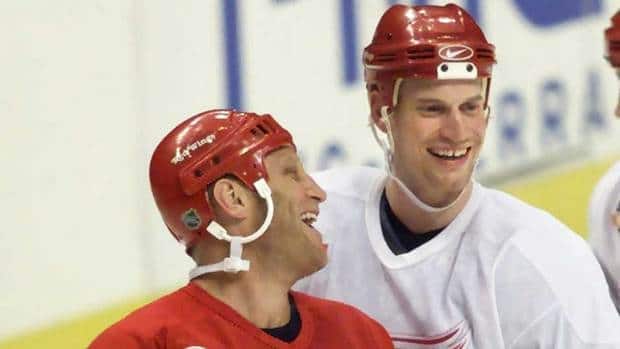
So I was pleasantly surprised when Max Bultman reported Kris Draper was being moved to oversee pro scouting so that Jesse Wallin could be elevated to the director role for the amateur scouting group.
Replacing Drapes
Dealing with the Draper news first, I am happy to see him moved out of amateur scouting; since being placed into the role of overseeing amateur scouting in 2019, there was never much to indicate he was good at identifying amateur talent. He largely continued on with the draft philosophy held by the previous director Tyler Wright: draft big players who play a solid two-way game but have questionable offensive talent.
I’ve often bucketed prospects by whether they were drafted out of North America or Europe, and when you look at Detroit’s drafts through this lens, the prospects out of Europe regularly outperform draft picks out of North America. Then, when you look at Canada in particular, the single biggest source of hockey talent on the planet, Detroit’s drafting has been completely unacceptable.
North American Draft Picks from the first Three Rounds
2019: Robert Mastrosimone
2020: Cross Hanas, Donovan Sebrango
2021: Sebastian Cossa, Shai Buium, Carter Mazur
2022: Dylan James
2023: Nate Danielson, Trey Augustine, Andrew Gibson, Brady Cleveland
2024: Max Plante, Ondrej Becher
2025: Carter Bear, Michal Pradel
2026: JP Hurlbert, Victor Plante, Michal Orsulak
Detroit got absolutely nothing out of those first four drafts when Draper was either overseeing or heavily involved in amateur scouting. While Tyler Wright was still with the team for the 2019 draft, it was clear he would be following Ken Holland to Edmonton shortly after the draft.
I do like Trey Augustine (currently my #2 ranked prospect), and Max Plante (whom I rank as the #1 prospect), and I have reasonably high hopes for Carter Bear, but it begs the question: how did the improvement in draft selection come about?
Drafting appears to have improved since 2023, and I suspect Wallin played a larger role in North American scouting given the fact he’s being elevated to the top spot.
I have long believed Wallin was the best person among the current front office staff to oversee this group — head of European scouting Håkan Andersson is believed to have turned down the role in 2019 in order to remain in Europe — and that’s due largely to Wallin’s work with the St Louis Blues before being hired by Steve Yzerman.
Here are the key draft picks the Blues made while Wallin was part of their scouting group:
2014 Draft
21st overall pick: Robert Fabbri
33rd overall pick: Ivan Barbashev
82nd overall pick: Jake Walman
94th overall pick: Ville Husso
2015 Draft
56th overall pick: Vince Dunn
2016 Draft
26th overall pick: Tage Thompson
35th overall pick: Jordan Kyrou
2017 Draft
20th overall pick: Robert Thomas
Those are some spectacular draft classes, with a high percentage of those hits being forwards, which is an area where Detroit currently has little in the way of elite talent.
The hope is guys like Carter Bear and JP Hurlbert can develop into top 6 forwards, with future draft classes adding additional pieces to the prospect pipeline. Given the Red Wings have struggled to lure premium free agents, it’s going to be essential to make the most of their draft capital, and there’s reason to believe they are finally on the path do just that.
It’s a good sign Jesse Wallin — one of the few people in the Red Wings’ front office to prove himself outside of the organization — has been able to break through the country club front office culture that seemed to only promote former players from the 1990s and 2000s who never got any experience elsewhere. The addition of Mark Leach, another guy with loads of experience outside of the country club, provides another sign of green shoots beginning to poke their way out through the rubble.