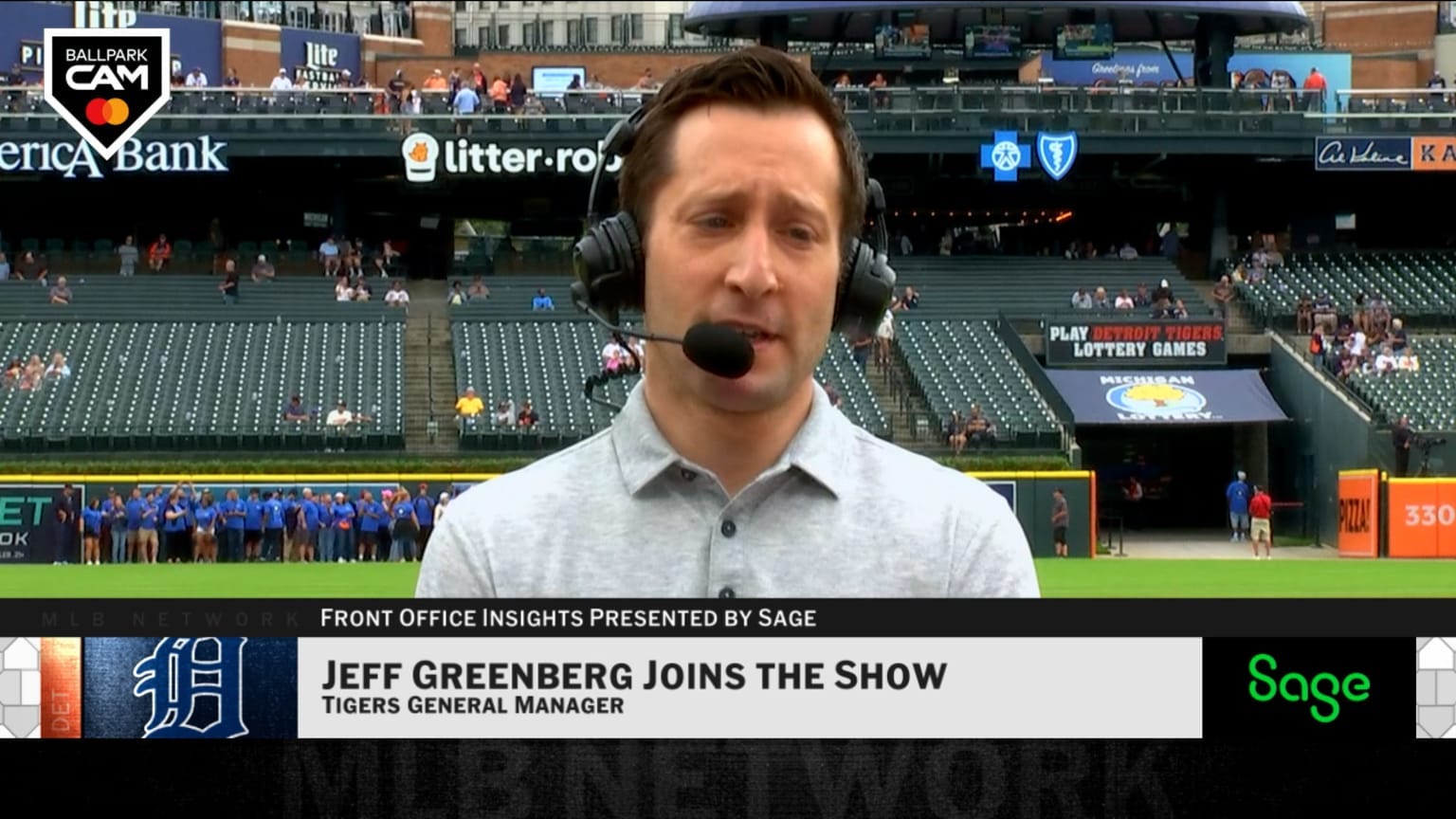
How Jeff Greenberg Would Fit the Red Wings
Taking a close look at potential candidates to lead Detroit's hockey ops department
As has often been the case with these pieces, I will lay my cards out from the drop: I don’t see why Jeff Greenberg would leave the Tigers’ front office for the same role with a struggling Red Wings franchise. On the one hand, he’s helped turn the Tigers around, as the franchise has made two straight post-seasons, and — if not for a brutal stretch of injury luck and poor play through May 31 that saw the team play at an underwhelming .361 clip — would be firmly in the playoff picture given they have been playing .613 ball since July 1st.
He’s currently filling one of the dozens of GM roles across big-time sports and is poised to enjoy the fruits of his labor, so why leave?
On the other, if he wants to be a VP or president of an operations department for a professional sports franchise, that could happen in a matter of weeks if not days should Chris Ilitch tap him to oversee his struggling hockey franchise. It’s a consideration many make during their careers, and we often opt for the more prestigious title and the salary bump. He may also look at the opportunity to turn around the most successful NHL franchise in the United States, and consider it a challenge too good to pass up.
To add in yet another layer, it is believed MLB is going to lock out players in an attempt to reign in player salaries, and if that happens, Greenberg may want to transition to a league where relations between players and owners are on more solid footing.
In this article I’m going to cover Jeff Greenberg’s candidacy to become the Red Wings’ head of hockey operations, as that seems to me the most likely role he’d accept if he was to leave the Tigers’ front office.
Jeff Greenberg’s Background
The biggest criticism to this point regarding Greenberg’s qualifications has been the fact he’s a baseball guy, despite spending 17 months working for the Chicago Blackhawks before returning to MLB in Detroit.
He understood fairly early on that if he wanted to be involved in pro sports, that was most likely to happen as a front office exec:
I got my first internship in baseball in the summer of 2006, and at that time, you know, for guys like me who weren’t playing professionally, it seemed like there was more opportunity in baseball. And I was lucky enough to get an internship with my hometown team, the Pirates, and just kind of went from there.
-Jeff Greenberg on his career choice
The book Moneyball launched many analytics-driven careers in MLB; Corsi, however, was slow to gain widespread adoption in NHL front offices. For those who started their careers in the mid-aughts, MLB was the obvious career path as front offices across the league embraced advanced analytics. If Greenberg was 15 years younger, perhaps he would have chosen the NHL as a career path.
In college, during his undergrad studies, he interned for the Pittsburgh Pirates; in law school he interned for the Arizona Diamondbacks and Major League Baseball. He then went on to spend more than a decade working for the Chicago Cubs organization. Finally he’s spent three years in the Detroit Tigers’ front office.
So despite a background in low level hockey — he played the sport in high school and college at the club level — and brief dalliance with the NHL in Chicago, Greenberg seems like a baseball guy.
During his time on the north side of the Windy City, the Cubs had a resurgence for the ages, making the playoffs 5 out of 6 seasons, making it to three NL Championship Series, breaking through in 2016, claiming their first World Series championship in 108 years. Greenberg was rewarded for his work by being promoted to director of baseball operations in 2018.
His father was once a part-owner the Texas Rangers for a hot minute. The elder Greenberg also helped Mario Lemieux buy the hometown Pittsburgh Penguins, enabling the team to stay in the area in a time of great economic uncertainty for the club. While he could have easily gotten a job in the NHL, Jeff Greenberg chose baseball as his career path with its early embrace of analytical decision making.
During his time with the Cubs, one of Greenberg’s roles was to manage pro scouting and that has been reported as the focus for his work during his time with the Tigers. Pro scouting has been a massive issue for the Red Wings, so you can see why this aspect of Greenberg’s experience would interest Chris Ilitch.
Let’s take a closer look at Greenberg’s role with the Blackhawks. While it was brief, it does give us some insight into how he made the case to be the GM to replace Stan Bowman.
Chicago Blackhawks: April 2022 to September 2023
There were three factors that made Jeff Greenberg an interesting candidate for the Blackhawks as their next GM:
The Cubs’ front office, headlined by Theo Epstein, ended the Cubs’ 108 years of futility by winning the World Series in 2016, which made the Cubs an interesting case study across North American professional sports organizations. Greenberg got some of that shine as a front office exec.
Greenberg had a lot of experience with the Cubs as an analytics-focused executive, and the NHL had just begun its slow embrace of analytics in 2016 when current Leafs GM John Chayka became GM for the Arizona Coyotes.
He had a background in hockey, having played in high school and college, so despite the total lack of NHL experience, he was able to talk knowledgeably about the sport in general and the Blackhawks in particular.
Patrick Mooney and Scott Powers from the Athletic wrote an article covering his candidacy, with this passage providing a good overview of his approach when interviewing for the GM role:
Greenberg possessed enough hockey knowledge — especially about the Blackhawks — to be a viable candidate. But he also acknowledged that he would need assistance in several areas, the resources to hire a strong group around him. The interviews revolved around big ideas — setting up systems for scouting, player development, R&D and high performance, a catch-all term for the medical/training/technological aspects of an organization — more than granular details about the roster or hockey strategy.
It’s been reported that in his interview with Blackhawks senior executives, Greenberg emphasized building out their scouting department:
He talked about going down to the grassroots level and really allocating a lot of funds to a scouting staff and having a boots-to-the-ground mentality,” a source said. “There are no shortcuts to scouting players, but a lot of teams will nickel and dime their staff when it comes to scouting.
The way you build a sports franchise — whether it’s baseball, hockey or whatever — you have to draft well. In five years, you’re going to be evaluated on whether you found useful players in the third or fourth round.
This is of course very true in the NHL, and it’s been an issue for the Red Wings for a long time. So you could see this resonating with Chris Ilitch.
However the Blackhawks opted for the comfort of the internal candidate and tore up the interim GM tag from Kyle Davidson, naming him their permanent GM. With analytics becoming an area of interest across the NHL, the Blackhawks hired Greenberg to be an associate GM, and let him build out his analytics team.
During his brief time with the Blackhawks, they hired 11 analysts, with one coming over from the Islanders, and one moving over from the scouting department to serve as an analyst.
Here’s how those hires have worked out:
Two received promotions: Chris McConkle was elevated to manager of hockey operations and Mark Weinstein left the organization to become director of analytics for the Pittsburgh Penguins.
Six are still with the club.
Three appear to no longer work in the NHL.
On the surface that looks pretty solid. We’ll also take a closer look as Chicago’s draft record given Greenberg placed heavy emphasis on drafting and player development when he interviewed for the GM role.
One interesting detail is that one year after assuming the AGM role, Elliotte Friedman reported that the Pittsburgh Penguins were considering interviewing Greenberg for their GM role in 2023 after parting ways with Ron Hextall.
The Blackhawks denied Pittsburgh’s request, which is an unusual move. Typically, when an executive is interviewing for a promotion, they are granted the opportunity to interview, but this was not the case with Greenberg. Perhaps this played a role in Greenberg heading back to MLB so soon after joining the Blackhawks.
All this short stint with the Blackhawks does is further cloud how much interest Greenberg has in the NHL and what sort of executive he’d be were he to run his own organization?
My big picture take is that on the one hand, sports are sports, and with both MLB and now the NHL embracing analytics, someone with Greenberg’s background would be an intriguing candidate.
Your take on Greenberg’s qualifications is likely going to depend on how important you think it is for the head of hockey ops to be an NHL lifer. If you don’t care one bit, Greenberg is an intriguing candidate; if you highly value decades of NHL experience, Greenberg isn’t the least bit qualified.
He had his shot to burnish his bonafides in the Windy City, but bailed after essentially one full NHL season.
Greenberg’s Analytical Background
When you hear suggestions that Chris Ilitch wants a front office team who will rely on the use of analytics to drive their decision making process, it would be tough to find an NHL executive with more tangible experience than Greenberg. When ESPN’s Jeff Passan wrote on Greenberg’s move to the Tigers, he had this to say about Greenberg’s reputation in his short stint with the Blackhawks:
With the Blackhawks, Greenberg built the foundation for one of the strongest analytics departments in the NHL, which now has more than 10 staffers and will continue to implement the systems Greenberg put in place.
I can read your mind, you are thinking ‘but the Blackhawks have been one of the worst teams in the NHL since Greenberg arrived in 2022, consistently finishing as one of the two worst franchises for three years running’.
If this makes you skeptical, particularly given how quickly Greenberg left the Blackhawk organization, I can’t say I blame you one bit. Even looking at the advanced stats, the Blackhawks have consistently been one of the 2 or 3 worst teams in the entire league since Greenberg built out their analytics team.
They’ve shown no signs of life.
Greenberg would obviously have to make the case to Chris Ilitch for why things have gone so badly with Chicago’s NHL franchise. While he can share the success he’s had in his time with the Detroit Tigers, the fact Chicago has performed so poorly despite having a #1 overall pick, two more top 3 picks, and seven top 20 picks since 2022 is not a great look. You have to go all the way back to the 2020 draft to find a draft pick outside of the first round who’s played more than 100 NHL games.
Using Greenberg’s own words as far as what his goals were in Chicago, you can’t help but be deeply skeptical about how well he could run an NHL franchise. This is particularly true when you consider Greenberg’s past history with the Cubs and the fact the NHL was in the nascent stages of their data revolution that finally bore fruit this past season with the Canes claiming their second Cup in franchise history.
Meghyn Chayka, who runs the analytics service Stathletes, has commented that MLB organizations have dozens of people in their front office analytics departments, while NHL teams have ‘three guys who show up in track suits’. So if that’s still the case with many NHL front offices, it’s tough to understand why one of the stronger analytical groups in the league, put together by a guy who has experienced nothing but success in MLB, has faltered so badly.
At least Greenberg’s time with the Tigers since then has been a total success.
From 2013 to 2023, the Tigers averaged 69.5 wins — I’ve omitted the Covid-shortened 2020 season; since Greenberg’s arrival, the club has averaged 86.5 wins the previous two seasons. If they maintain that .613 winning clip the rest of the way, it would result in the team winning 83 games, which isn’t all that bad considering the string of injuries they suffered at the start of the season.
They also have an intriguing lineup filled with young talent, headlined by rookie sensation Kevin McGonigle.
While it’s indisputable Greenberg has been a highly successful front office exec in MLB, it’s totally reasonable to question how well he would do leading the Red Wings given what we’ve seen from the Blackhawks both during his short stint there and in their performance since he left.
Is Jeff Greenberg a Good Choice?
Man, this is a tough one. From a baseball perspective, 100% yes. He played a key role in overseeing pro scouting at a time when the Cubs had their greatest success in over a century. The Tigers have completely changed their fortunes since he arrived, matching the Yankees in run differential this season despite spending $100 million less in player salaries. If not for some horrific injury luck, they could very well be the best team in the American League, and even with that horrific luck, they are tied with the Yankees and Red Sox for the best pythWL in the American League.
He should 100% be in line to oversee operations for an MLB team.
But hockey? I’m legit conflicted here. In fact, if he never worked for the Blackhawks I’d likely be more supportive. That’s how conflicted I am about his time with Chicago’s NHL franchise.
The key reasons for my skepticism are as follows:
One of the primary reasons he was considered for the Blackhawks GM role was to make a clean break from the Stan Bowman era that resulted in a massive sexual assault scandal that took place in 2010. They obviously went on to hire him as associate general manager, but that was a stated motivation that was put forward at the time he was being considered for the GM role.
When the Blackhawks instead selected Kyle Davidson as GM, Greenberg accepted a role as associate general manager. It’s rare for someone to miss out on a spot that would be a clear promotion and then accept a lateral move with that organization.
In his interviews for the Blackhawks GM role, he focused on scouting, the NHL entry draft, and player development as key areas to turn the franchise around. Despite lots of lottery success, the Blackhawks have been one of the worst teams in the league over the past 4 seasons, and that’s true by any measure of performance you care to use.
He has been credited with building out one of the more robust analytical groups in the entire NHL, however there is precious little to show for it in a league that has largely been slow to embrace Moneyball analytics.
To be fair to Greenberg, there were legit questions about whether the Blackhawks could turn things around in 3 - 5 years, or whether it would take closer to a decade. The organization has solid center depth in Connor Bedard, Frank Nazar and Anton Frondell, and — as we’ve seen in Detroit — center depth is essential if you want to become competitive in the NHL.
Shortly after he was hired by the Blackhawks, he was believed to be a candidate for the GM spot with the Pittsburgh Penguins, with Chicago ultimately putting the kibosh on that move by denying him the opportunity to interview. The big question is whether he was legitimately interested in a GM position in the NHL? Leaving Chicago after one NHL season pretty much suggests he wasn’t all that committed to a career change.
On the plus side, should he make the move to the Red Wings, he may be tasked with focusing on pro scouting, which has been a clear strength for him in MLB. He’s also self aware enough to know that he’d need a lot of help were he to transition back to the NHL. I think that’s the best case for how to put a good spin on his time with the Blackhawks: in Detroit he would need a very strong GM who knows the league extremely well and is highly capable of using analytics to make his case to Greenberg and, by extension, Chris Ilitch.
If Chris Ilitch could pair Jeff Greenberg with one of the top analytics-based AGMs in the NHL, like say Tyler Dellow, the two could work very well together. As stated above, Greenberg was very honest in his interviews with the Blackhawks in acknowledging he would need help, and the concern with someone who is very heavy into analytics but may not have a strong strategic viewpoint on style of play is that your roster may not be cohesive.
In baseball, you are looking at fairly discrete skill sets like pitching, hitting, base running and fielding. With hockey, there are many considerations when it comes to style of play — both with and without the puck — and someone who doesn’t have strong familiarity with the league may struggle to come up with a coherent strategy.
When listening to Brett Peterson talk about the Florida Panthers roster, it’s clear they have an identity. I think Dellow, given his work with both New Jersey and Carolina, could provide that strategic vision, in addition to the analytical basis for his decisions as GM.
With all that said, I’ll end this piece by saying Jeff Greenberg has had plenty of time within the Detroit Tigers’ organization for Chris Ilitch to have formed an opinion on him. With Elliotte Friedman offering up Greenberg as a potential candidate to oversee hockey operations, I think there’s a decent chance he ends up leading the Red Wings. Friedman said the same thing about Jeff Greenberg when Pittsburgh was looking to replace Ron Hextall as GM, and this time around the only person who could block Greenberg from interviewing is the guy who would be interviewing him.
If that’s the case, Jeff Greenberg’s general manager will be the single most important hire he makes.


